HOW TO SPOT SCAMMERS AND AI “ARTISTS” IN YOUR BOOK ART SEARCH: Green Flags vs. Red Flags by Anna Leitensdorfer
 Today we welcome back Anna Leitensdorfer to Writer’s Fun Zone. She is stopping by to chat with us about “HOW TO SPOT SCAMMERS AND AI “ARTISTS” IN YOUR BOOK ART SEARCH: Green Flags vs. Red Flags.” Enjoy!
***
One of an author’s largest struggles when publishing their book is looking for artists to make their book cover — and any other art-related things that will help accentuate the book!
After all, book covers are one of the first things readers look at.
Plus, nowadays many authors look to character art and interior art to not only decorate their books but to also use it for promotional marketing on social media…and special editions may have illustrated endpapers, sprayed edges, and bookish merch like stickers to really add that little extra pizzazz.
So, how do we separate the scammers from the real ones?
RED FLAGS
1. Direct Messages (DMs)
Social media is a jungle out there.
Do not answer any direct messages from “artists” pestering you for commission work.
They are most likely scammers.
However, if you met an artist on Instagram or another platform in the comments section, for example, and both of you mutually agree to go to direct messaging, then that’s totally fine.
The messaging must be mutual.
From an artist’s standpoint, it’s a lot better if the author reaches out to ME rather than I reach out to THEM.
Also, don’t be afraid to block artists if they continually pester you for work after you said no.
2. Social Media Presence
A good way to see if your artist is legitimate is to look at their social media.
If their account looks fairly new, then stay clear.
Many scammers will create bot accounts that were just made last week.
Low follower count, not a lot of posts, or none at all can also be good indicators.
Plus, see if you can look up their social media tag on other platforms.
For example, my Instagram handle is the same on Threads, TikTok, and X, so it’s easy to find me wherever you look.
Not to mention if you suddenly see artwork on their social media that you know you saw a month before the account was even made, they may be stealing artwork from other artists.
Don’t be afraid to out them at that point to help save others from being scammed.
3. No Consistent or Naturally Evolving Style
Be suspicious of “artists” who used to draw terribly, then 1 week later are posting artworks that are fully rendered realism without any warning or indication that they were doing so.
Something ain’t right there.
I draw in about 3 different styles, but you can see I have been naturally evolving with those styles (as I experiment to get better at my craft) long before AI appeared, and the progression can be seen on my Instagram.
After all, we artists learn from our mistakes.
It’s how we evolve.
If I suddenly created photorealistic artwork after showing no progression to how I got there, it would look very suspicious.
Other tells include fingers, clothing, and hair “melting” into other aspects of the piece.
If you ever suspect something you see or something an artist you commissioned sent you is AI, you can always have an artist friend help you look for inconsistencies.
In some cases, you may be able to ask the artist if they have the drawing or sketch phase of the artwork under the guise of curiosity without explicitly accusing them of AI.
I personally wouldn’t mind, as I would rather someone ask because they’re curious instead of outright accusing me of using AI without any proof (which has happened before, and they got real quiet after I showed them work-in-progress pictures).
Also, do not be afraid to add a “No AI” clause in a contract that an artist sends you, so if the work turns out to be AI, they are in breach of contract, and you may be able to take legal action.
- Side note: Do not submit ANY artwork into an “AI Detector” website. 99% of the time, it will say partially AI or AI or something along those lines. That’s because AI is trained on stolen artwork, so of course, artwork made by real humans would appear as AI, even when it’s not.
4. Payment Up Front
While this is more of a gray area, if an artist requires payment in full before starting a project, it may be a scammer.
My payments are made upon completion of work for X amount of dollars.
Others may ask for a small deposit to add you to their schedule, which will then count toward your commission, and then the rest upon completion.
Half up front, then half upon completion, is also a common payment method.
Any artist worth their salt will explicitly state payment type in their contracts.
5. Lack of Previous Works
If they can’t provide you with references, such as what other clients they worked with, for example (such as “I did artwork for this book, here is the link to purchase it”), it will not help their credibility.
This is also a great way to vet artists, as you can follow the trail to who commissioned the artwork (see the Previous Works section under Green Flags).
GREEN FLAGS
1. Ease of Discoverability
Good artists will not “hide” themselves.
They will not make it difficult for you to find their portfolio and other social media handles.
Many keep links in their bio, so looking at them more in-depth is only a few clicks away.
Don’t be too discouraged if they just have Instagram and a website, though.
I’d take a website over 5 social media accounts any day.
2. Website
Now, some artists will solely have their portfolio on sites like Instagram; however, I am a firm believer in a website for professional perusal.
Professionals will have their website linked to their social media, or an easy Google search will pop up.
In addition, their website domain name will look professional/reflect their business name (websites that were created for free on sites like Wix will have a “yourdomainname.wixsite.com” as part of the web address).
Artists who keep much of their portfolio on a website will more than likely purchase a domain name + pay to host the website on whatever platform they choose.
For example, my website is www.annaleitensdorfer.com, which does not have “.wixsite” after my name, since I own the domain name and pay for hosting through Wix.
3. Branding
If an artist has consistent branding across their entire online presence, then that makes for a very green flag (I say online since that’s how many authors find artists, though it’s also good to see in print media as well).
If their logo is seen across all their social media pages/website, that means they took the time to make sure their brand is recognizable regardless of where you see it.
Plus, scammers typically are not that detail-oriented.
4. Previous Works
Artists who call out who they did the work for is a major key.
You can then look up the author’s name (in this case) and see if the author has the artwork posted on their social media, or if you really want to be thorough, you can politely ask to message or email the author to ask how their experience was with that artist.
I list any work I have done for an author with their name, book title, and publication date (if applicable).
This is all done with permission from the author.
5. Contracts and/or a Licensing Agreement
Any artist who works on commissions MUST have some sort of contract.
These contracts are made to protect both you, as the client, and the artist.
No verbal agreements!
Get it all in writing!
However, please read over any contracts you receive carefully before signing.
This goes for pretty much anything, regardless of what type of work it is.
Some contracts will have a Licensing Agreement built in, but I have mine on a separate document, which lays out commercial licensing (what you can and can’t do with the artwork).
6. Works-in-Progress
In this day and age of AI, we artists must be extra careful to prove we are not making AI slop.
Artists who are open about sharing their process, such as having screen recordings, process videos, or JPEGS of the different stages of an artwork, help add more to their legitimacy.
Plus, should you hire an artist, DO NOT BE AFRAID to ask for progress pictures throughout your commission.
An artist who has nothing to hide will be happy to provide them to you.
This is also a way to catch an AI scammer if they fail to provide any proof of original work — or if they just send you a finished work without you even seeing any sketch phases!
I regularly post on my social media progress pictures (with the author’s permission) and send progress pictures via email to the client frequently during the project.
- Side note: In the future, AI may be able to copy/mimic process videos. Some tells include weirdly fluid movement and blending into surroundings. Of course, follow your gut feeling if something feels off.
7. Communication
We love being on the same page!
Artists who check in with you weekly with updates or ask questions during the project to make sure they get everything the way you want are golden.
I provide progress pictures in a PDF flat book with my branding on it during certain stages of an artwork.
Too many times, I have seen authors get ghosted by artists after they commission a work, or they don’t have it even close to finish when the deadline comes around, and then the author has to move on and find a new artist.
I predominantly communicate through email once contracts are signed, as I personally find it more professional, and the author has records of everything we send to each other.
8. They are just as excited about the project as you!
We want to get lost learning about your world, your characters, and your story.
It’s also about building trust and a rapport with the authors, as we want to see you succeed, too!
9. Transparency
Basically, all the points I have made thus far as far as green flags boil down to transparency.
It’s how an artist can build trust with their client, and how you can avoid being scammed.
This also ties into price transparency.
Green flag artists will have their prices listed on their website or on a pinned post on their Instagram.
In other words, you’re not digging for that information.
Some artists are solely custom-price based because every commission they do may not be able to have a standard pricing structure.
That is a gray area, so I wouldn’t discount them; however, do your research on them to vet them first before contacting for pricing.
Conclusion
I hope this guide took out some of the stress when it comes to vetting artists.
Now that you’re an expert on green flags vs. red flags, what kind of art will you be seeking for your book?
***
About the Author
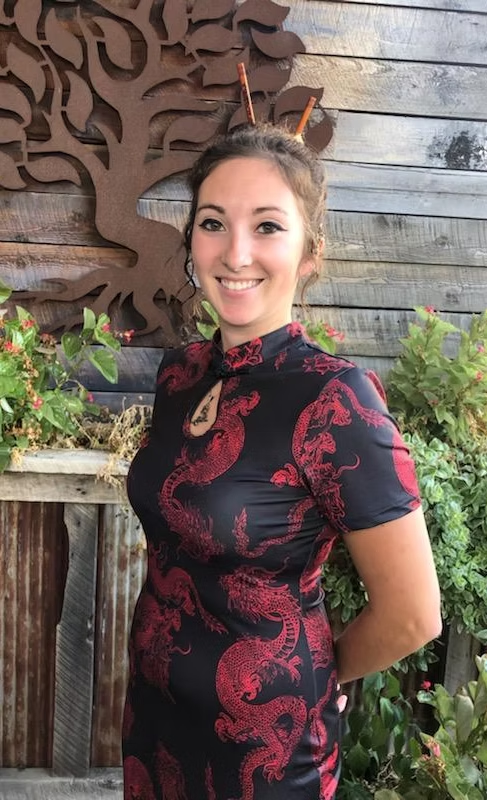 Anna Leitensdorfer is an illustrator, animator, and author who began offering creative services to fellow writers in 2024.
She provides illustration for children’s books, storyboarding, cover design, character art, interior art, maps, and promotional artwork for marketing.
A 2018 graduate of the Savannah College of Art and Design with a degree in Animation, Anna continues to pursue her passion for storytelling through visual media.
She is currently developing her original animated feature film, Art of Auld Lang Syne, while also expanding her work in book design and print formatting.
In addition to supporting other authors, Anna writes her own fiction and recently completed a supernatural horror manuscript.
When she’s not behind her drawing tablet, she can usually be found playing video games or taking her two “little monsters,” Shelby and Percy, bowling.
She is open to commissions in animation, game design, and illustration.