AI Content Licensing for Authors: Julie Trelstad
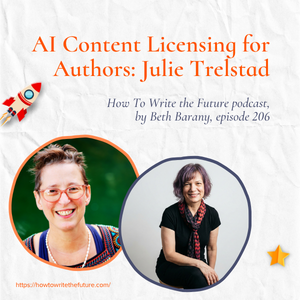
AI Content Licensing for Authors: Julie Trelstad
***
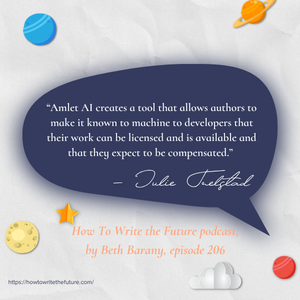
“Amlet AI creates a tool that allows authors to make it known to machine to developers that their work can be licensed and is available and that they expect to be compensated.” – Julie Trelstad
In this How To Write the Future podcast episode, titled “AI Content Licensing for Authors: Julie Trelstad,” host Beth Barany interviews publishing professional, Julie Trelstad. Julie shares her publishing journey, what AI content licensing is, and how authors and publishers can protect themselves against copyright or AI theft by using the newly created Amlet AI.
Amlet AI is a platform where authors can register books with machine‑readable metadata to enable licensing, compensation, and control over AI training use; it covers European deadlines, opt‑out options, ISCC standards, metadata enrichment.
Platforms the podcast is available on: Apple Podcasts | Buzzsprout | Spotify| YouTube
RESOURCES
StreetLib Distribution: https://www.streetlib.com/
Writing Tool: https://paperbacksandpixels.com/book-description-autopsy
FOR CREATIVE WRITING PROFESSIONALS – BUILD YOUR BUSINESS SERVING WRITERS
Sign up to be notified when our training opens and get a short Creative Business Style Quiz to help you create success.
https://bethbarany.com/apprenticeship/
Support our work for creatives!
Buy me a coffee: https://ko-fi.com/bethbarany
GET HELP WITH YOUR WORLD BUILDING – START HERE
Free World Building Workbook for Fiction Writers: https://writersfunzone.com/blog/world-building-resources/
GET SUPPORT FOR YOUR FICTION WRITING BY A NOVELIST AND WRITING TEACHER AND COACH
Schedule an exploratory call here and see if Beth can support you today: https://writersfunzone.com/blog/discovery-call/
About the How To Write the Future podcast
The How To Write The Future podcast is for science fiction and fantasy writers who want to write positive futures and successfully bring those stories out into the marketplace. Hosted by Beth Barany, science fiction novelist and creativity coach for writers. We cover tips for fiction writers. This podcast is for readers too if you’re at all curious about the future of humanity.
This podcast is for you if you have questions like:
– How do I create a believable world for my science fiction story?
– How do I figure out what’s not working if my story feels flat?
– How do I make my story more interesting and alive?
This podcast is for readers, too, if you’re at all curious about the future of humanity.
ABOUT JULIE TRELSTAD
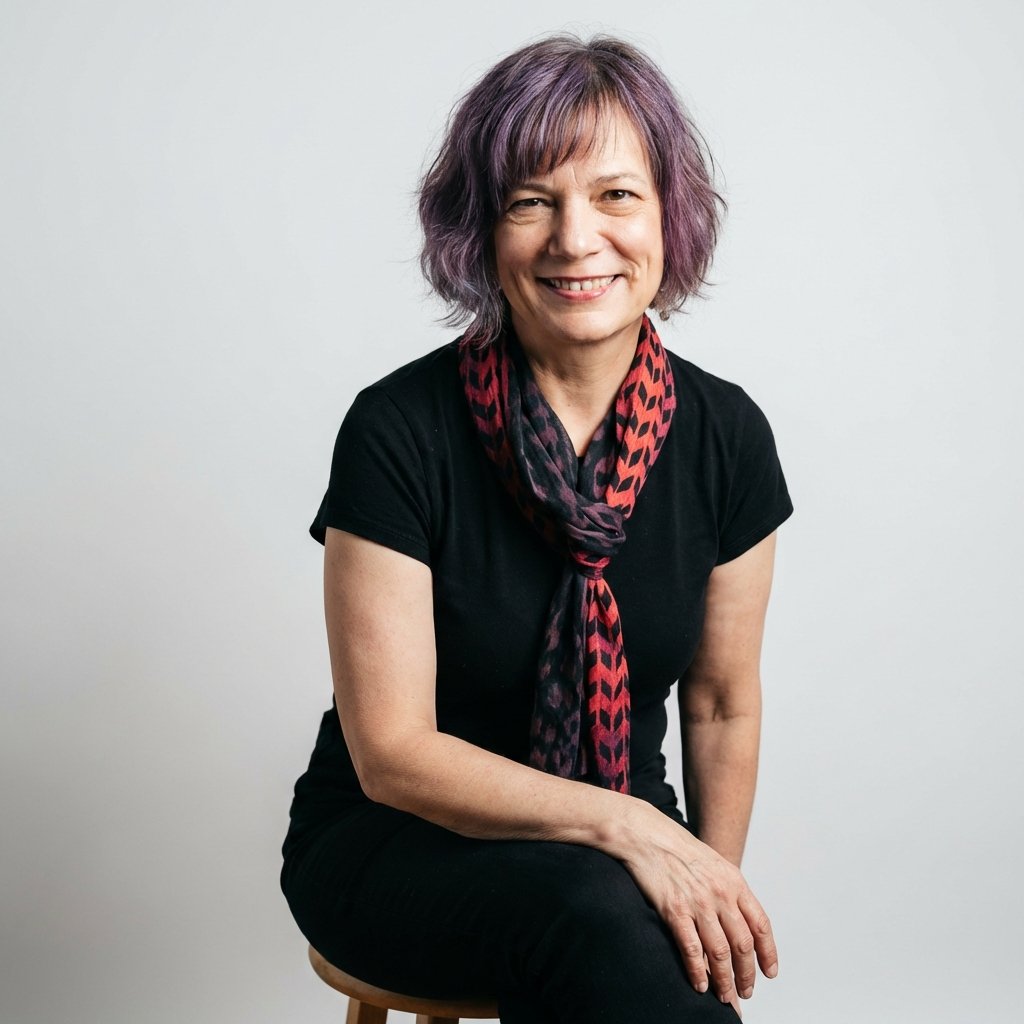 Julie Trelstad is the founder of Paperbacks & Pixels, where she coaches authors on building publishing platforms with AI as a collaborator. She has been in publishing since 1989. Originally trained as an architect at Columbia and Parsons, she ran the Architectural Graphic Standards franchise at John Wiley & Sons, acquired Sarah Susanka’s The Not-So-Big House at The Taunton Press, served as Director of Digital Rights at Writers House, and led US Publishing at StreetLib. She is also Head of US Publishing at Amlet AI, an AI rights registry helping authors and publishers participate in AI licensing on fair terms.
https://paperbacksandpixels.com
Run a free AI-driven autopsy on your book description with resuscitation instructions. paperbacksandpixels.com/book-description-autopsy
Instagram: https://www.instagram.com/paperbacksnpixels
LinkedIn: https://www.linkedin.com/in/julietrelstad
Transcript for episode 206 – AI Content Licensing for Authors: Julie Trelstad
Welcome and Introductions
BETH BARANY: Hi everyone. Welcome to How to Write the Future Podcast. I’m your host, Beth Barany. I am very excited to have a special guest with me today, Julie Trelstad.
Julie, can you tell us a little bit about yourself and what brought you to our show?
[00:16] Julie’s Publishing Journey
JULIE TRELSTAD: Yeah, I have been a book publishing person for my entire career. But I was an Acquisitions Editor, buying architecture books for publishers like Reader’s Digest and John Wiley and Sons and Sterling, which was part of Barnes and Noble before I went off and started a publishing company.
And then Borders went under with my whole publishing company. And since then I’ve been working in the digital space with authors and publishing companies, helping authors self-publish, helping them build platforms, and also helping people like literary agents and, and digital publishers, run their businesses.
BETH BARANY: So really helping people on the backend of their business.
JULIE TRELSTAD: Exactly.
[00:54] What AI Content Licensing Means
BETH BARANY: So I understand that you are also in the AI content licensing space.
JULIE TRELSTAD: Yes.
BETH BARANY: Very interesting. Can you tell us about that? I have not even dabbled into that. I mean, I’ve heard about it, but I don’t know anything about it.
JULIE TRELSTAD: It is brand new. It truly is. The whole concept between AI licensing around AI licensing is that AI reads a heck of a lot of books. And what happened in the last couple of years, I’m sure you’ve heard a lot about, Anthropic, Claude OpenAI, they all built their models, trained on novels. and fun fact these, no, Anthropic was around our, our actually OpenAI was around a long time before they actually launched it as a product. And it wasn’t until they started feeding it fiction that it began to be able to talk to people and have this conversational style that really became essential to the products.
But in order to do that, no publisher was gonna say, sure, you can feed my books to a robot. So, the developers ended up building these models based on big databases of pirated books and in the United States, that is against the law. In Europe, it’s really against the law because models aren’t even allowed to train on any copyrighted content without author compensation, which is something we can talk about in a bit.
So licensing on the long wind around that is a way for AI companies and developers to compensate authors for the very, very valuable human created content that is used to trade models or to do deep research or to, be used in the chat bot applications that are being built, by not just the big guys, but you know, thousands of developers or building applications and are using content to enrich these applications and authors need to be paid.
So Amlet AI creates a tool that allows authors to make it known to developers that their work can be licensed and is available and that they expect to be compensated.
[02:59] How Authors Register and Get Paid
BETH BARANY: Oh, so what do I do? I’m an author. I have 12 novels out, five nonfiction books. Do I just say here Amlet, put my books into your database or do I have to pay them?
JULIE TRELSTAD: You can. So Amlet AI was created by the same people who have StreetLib Distribution. So one thing you can do as an independent author is put all of your books in StreetLib Distribution and that automatically gets you into the Amlet AI system.
The individual registration is free, but StreetLib Distribution has like a $300 2.99 one time setup fee, which is a lifetime license to use StreetLib. It also gives you global distribution, so that will get you into bookstores across Europe with your digital books. So there’s a lot of benefit for being in that, but the but, and there’s no per book cost.
[03:49] Europe Deadline and Opt Out Choices
You can upload all 12 of your books and immediately be registered. And it’s a really good time to do it because in August, by August of next year anyone who has not registered their book in a machine readable way, and Amlet is the only one that I know of that is accessible to self-publishing Authors currently, will not be able to be compensated in Europe under their laws. So you actually have to register in a way that the European authorities can find you by August or you will miss out on all the European revenue that you could get, even if you’re an American.
I think sometime in August, 2026 is when you have to be registered.Everyone who’s distributing digital books in Europe. If the book is sold in Europe, and if you do not opt out, if you do not join a licensed registry, they’ll consider you like, oh, this content’s good to grab, and it will go uncompensated. If you don’t register, you will not be able to get compensation under the new law that’s taking effect this year.
And if you’re a larger publisher, StreetLib is, at no cost, at this moment bringing in databases but it’s like a bulk thing.
There will be a cost in the future that the model for Amlet is that we’ll take a percentage of the licensing revenue that you get in. So there is no cost at this moment to register your book.
BETH BARANY: And then StreetLib Distribution will put it into Amlet AI, which makes books available for engines to….
JULIE TRELSTAD: And the other thing it does in distribution, if say you’re using, StreetLib to get into Apple Books or Cobo or any other, the wide distribution and you can opt in or app, we may already be distributing there, it will send the signal to the retailer that that book is restricted and cannot be used for training from the retailer’s point of view either.
BETH BARANY: So you can register it, but decide, no, I don’t want my book used for licensing.
JULIE TRELSTAD: That is what everyone is doing right now,
BETH BARANY: Yeah.
JULIE TRELSTAD: Right? Because this whole set of like, how much are AI companies paying for a license? It’s all unsettled.
BETH BARANY: Yeah.
JULIE TRELSTAD: So, the default right now is everyone do not use it to train it but here I am and I’m available and if you wanna contact me to license this work, this is how you reach me. And it does it through a machine readable fingerprint of your book. The AI licensing that Amlet uses is actually based on the content of the book itself. So if somebody were to pirate your book or to use it without your permission, you would be able to compare your licensed book with their unlicensed book and have basis for a claim.
BETH BARANY: So it’s a way to put another layer of protection that a private company is doing. So this isn’t the copyright office, this isn’t the government. This is a private entity that would allow us to say, no I don’t want my books to be used for training data for the AI engines. Or, I do. And I am. I’m like, well, if they pay me a lot of money, I might consider it. So my default is no, but each will need to make their own decision.
[06:42] ISCC Standards and Legal Landscape
Do you ever foresee the US government or other governments making it easier, to go in one direction or another or to have this all a national licensing board or something like that?
JULIE TRELSTAD: It would be amazing but what we’re really looking at right now, and, and this company, Amlet.ai, is based in Milan. It was founded in, in Europe. It was founded in response to the fact that in 2019, Europe did pass law that said that every bit of copyrighted material that’s brought into computer applications needs to be compensated. That’s not true in the US.
In the US it’s illegal, you can’t pirate books, but you can go to the Strand and scan it so the author doesn’t necessarily have to get compensated. So it’s a shade of gray. And so, this particular Amlet was built, in order to comply with that law, right?
So this law was passed, and then the AI companies are like, we have no way of knowing what content is licensable or not. And so actually, one of the founders, Titusz Pan, who’s in Germany, created something called the ISCC, which is the International Standard Content Code.
Amlet then is built on top of that as very specifically for the book industry and very specifically for you to determine which rights you are giving or no rights at all to the AI companies.
[08:01] Being Findable in AI Search
What’s really interesting, Beth, is right now in the last year all these AI bots have gotten, so sci-fi right? have gone out into the inter, into the internet and they are actually digesting and reading books and then recommending them. So like one of these bots can read a million books in a day, right? And it can hold thousands of them in its context.
And in the morning it can deliver to your email box a summary of all these books, or all of this wrapped up together or recommend a book. So if your book is set up and registered for this kind of environment where bots are reading books first before people, it puts you, you know, miles ahead of people who aren’t thinking about this yet.
BETH BARANY: Yeah, I mean, I’ve been seeing lots of emails coming, well, a few emails coming through from, from one of the companies that I follow How do you make your book marketing efforts, findable by the AI search engines.
JULIE TRELSTAD: Yeah. Yeah.
[08:56] Metadata and Book Description Tools
So like there are little things we can do, but, but then registering with the AI so that like with Amlet, there’s like what we call an open API, which is the way computers talk to each other. So these developers can easily find your book, and also find what it’s about, and you enter the metadata along with, with your Amlet.ai.
BETH BARANY: Yeah, it’d be interesting if there’s additional metadata now we need to add to our book descriptions. Or is it just the standard book description category, keyword tropes, comps.
JULIE TRELSTAD: Yeah, exactly. But yeah, have those available, make them rich. definitely.
BETH BARANY: That’s great. I give my clients a metadata document template so they can build their metadata once they’re working on their editing, so that it’s much easier to have it on hand when they’re ready, you know, to publish. Yeah.
JULIE TRELSTAD: I love metadata. Yeah. Like one thing we’re working on in Amlet and StreetLib as well is to use AI to enrich the metadata. You know, to find more comps to, you know, review, to make sure that the, that the content in the book really matches what’s on the book page. You know, that’s a real problem actually.
And, and the, booksellers have gotten a lot more sophisticated. They’re using AI tools, right? And if they determine that what the content of your book doesn’t match what you say it is, that can really work against you.
BETH BARANY: Yeah, I mean, that is something that, I mean, I’m a big proponent for the creative needs to create and then use the AI tools to, adapt into other forms for marketing messages of all kinds, but you the creative, needs to sit down and be the one who does the creative work and work with other human beings to polish that thing up to a gem..
JULIE TRELSTAD: Agreed. Yeah.
I have a free tool on my website that’s based on this it’s a, it’s called the Book Description Autopsy. And you can, I actually, I’m working on it right now, but by the time this episode airs, it will be up and running. I fed it everything I know about making a good book description and, you can drop your book description in and it will tell you exactly what you need to do and if it is DOA or not.
BETH BARANY: Oh, that’s so great. I can’t wait to test that for you and to share it with everyone because what I’ve noticed is that there seems to be trends in how a book is marketed. Are you combining what you know with, from your history with all these AI tools and what they’re requiring?
[11:14] Positioning Tropes and Unique Pitch
JULIE TRELSTAD: Definitely I have this one and I have another. My favorite one was I was an acquisitions editor, nonfiction acquisitions editor for a really long time. And like the one thing that I always had to do when I brought a book in is I had to prove that this book was just like last year’s book. That was the bestseller. Or you know, it has that like a solid comp or solid backlog of comps.
Yet it is unique in all the world. So I’ve created a very specialized AI tool that helps authors figure out their positioning and their unique pitch. Like you don’t wanna be like any other author. And I think that what, that’s what we’re seeing now is like comps are always like really important, but we’re looking at it and we’re like, okay, this one got tweaked.
It’s like this, but a little different. I, I don’t think that’s really anything new, but it’s certainly something that I’ve doubled down on this year in terms of what the author brand is. And making sure that people are super unique, yet always mindful of the environment that they live in with other comp books.
BETH BARANY: I love it. Well, I feel like we could keep going and we’ll definitely have to have more conversations, because I’m very curious about where these new tools of AI are taking us as writers.
[12:26] Writing the Future Curveball
So I have a curve ball question for you that I like to give all my guests, which is when you hear how to write the future, what does that make you think of?
JULIE TRELSTAD: Well, I, you know, I write sci-fi too, and you know, I definitely will want to join– When I finish my draft, I’ll join your group.
I studied architecture and city planning before I got into publishing, and I’m still fascinated with that. And, my novels are always set in a world that is the future that I wanna see physically. Like it’s set in this place where the cars are gone and people walk everywhere and communities have been rearranged and changed and I have very interesting ideas about that just from my studies of city planning. And when I think of write the future, that’s what I like. You know, I want to write the future that I want to see in the world because I want people to think, oh, the world could be this way. That’s so cool.
BETH BARANY: I love it. I wanna read it. I wanna read it.
[13:21] Where to Find Julie and Wrap Up
So, Julie, if people want to reach out to you in your latest endeavors, where, where’s the best place that they can go?
JULIE TRELSTAD: Yeah, PaperbacksandPixels.com is where you can come and you can find the Book Description Autopsy and learn about my services. There’s a sly little link to find out about my writing there. And then, if you want to get your book registered within Amlet for AI training, that’s Amlet.ai.
And you can go there and/or you can sign up at StreetLib, but there’s information about that over at paperbacks and pixels. Or you can find out more if you’re an independent, Indie, how exactly to register your book for the future.
BETH BARANY: Fabulous. Fabulous. Well, Julie, thank you so much for being on today. I really enjoyed our conversation.
[14:02] Final Sign Off
Alright everyone. That’s it for this week, Write Long and prosper.
Loved this episode? Leave us a review and rating here: https://www.buzzsprout.com/2012061
Need instructions on how to leave a review? Go here.
***
Support our work for creatives: leave a tip: https://ko-fi.com/bethbarany
***
ABOUT BETH BARANY
Beth Barany is an award-winning fantasy and science fiction novelist and creativity coach for writers. They help novelists write, revise, and publish stories that matter—blending practical craft guidance with a big-picture commitment to imagination, meaning, and possibility.
Learn more about Beth Barany at these sites:
Author site / Coaching site / School of Fiction / Writer’s Fun Zone blog
CONNECT
Contact Beth: https://writersfunzone.com/blog/podcast/#tve-jump-185b4422580
Email: beth@bethbarany.com
LinkedIn:https://www.linkedin.com/in/bethbarany/
IG: https://www.instagram.com/bethbarany/
TT: https://www.tiktok.com/@bethbarany/
FB: https://www.facebook.com/bethbarany
X: https://twitter.com/BethBarany
CREDITS
- EDITED WITH DESCRIPT: https://www.descript.com?lmref=_w1WCA (Refer-a-Friend link)
- MUSIC CREDITS : Music from Uppbeat (free for Creators!): https://uppbeat.io/t/soundroll/fuzz-buzz License code: UMMKDRL02DFGKJ0L. “Fuzz buzz” by Soundroll. Commercial license: https://musicvine.com/track/soundroll/fuzz-buzz.
- DISTRIBUTED BY BUZZSPROUT: https://www.buzzsprout.com/?referrer_id=1994465 (Refer-a-Friend link)
- SHOW PRODUCTION BY Beth Barany
- SHOW CO-PRODUCTION + NOTES by Kerry-Ann McDade
c. 2026 BETH BARANY
For more “How To Write the Future” episodes, go here.
If you’d like to invite Beth onto your podcast, drop her a note here.
✅ Like the work we do? Tip us! https://ko-fi.com/bethbarany