
Edit Without Losing Your Creative Vision, How To Write the Future podcast, ep 229
Edit Without Losing Your Creative Vision – How To Write the Future podcast, episode 229
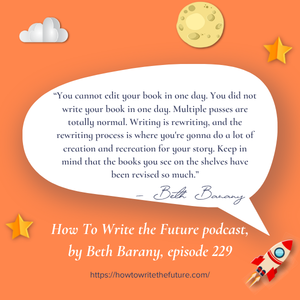
“You cannot edit your book in one day. You did not write your book in one day. Multiple passes are totally normal. Writing is rewriting, and the rewriting process is where you’re gonna do a lot of creation and recreation for your story. Keep in mind that the books you see on the shelves have been revised so much.”- Beth Barany
In this informative How To Write the Future podcast episode, titled “Edit Without Losing Your Creative Vision” host Beth Barany shares in detail how you can edit your novel without losing your vision.
Tips include: reading your first draft without fixing or adding touch ups so you get the authentic feel as a reader; defining your character and reader expectations; improving your characters arc; and how to build your revision plan.
Edit Without Losing Your Creative Vision will help guide you through the process, with an invitation to download the “Edit Your Novel Checklist“ to help you identify any problems you have along the way.
Platforms the podcast is available on: Apple Podcasts | Buzzsprout | Spotify| YouTube
RESOURCES
Support the podcast! https://ko-fi.com/bethbarany
Get the workbook: https://writersfunzone.com/blog/world-building-resources/
Join the Edit Lab! https://bethbarany.com/editlab
Edit Your Novel Checklist: https://bethbarany.thrivecart.com/edit-your-novel-checklist/
About the How To Write the Future podcast
The How To Write The Future podcast is for science fiction and fantasy writers who want to write positive futures and successfully bring those stories out into the marketplace. Hosted by Beth Barany, science fiction novelist and creativity coach for writers. We cover tips for fiction writers. This podcast is for readers too if you’re at all curious about the future of humanity.
This podcast is for you if you have questions like:
– How do I create a believable world for my science fiction story?
– How do I figure out what’s not working if my story feels flat?
– How do I make my story more interesting and alive?
This podcast is for readers, too, if you’re at all curious about the future of humanity.
Transcript for episode 229 Edit Without Losing Your Creative Vision
Edit Without Losing Vision
BETH BARANY: How to edit your science fiction or fantasy novel without losing your creative vision.
Today I’m going to talk about how to strengthen your story, understand your genre, and create a book readers can disappear into, all the while keeping what makes it yours.
First off, I want to say you finished your first draft. Congratulations. That’s an incredible accomplishment.
Now what?
If you’re wondering how to edit a fantasy novel or how to edit a science fiction novel, you may also be wondering, “How do I make this book better without losing the story I wanted to tell?”
You’re not interested in chasing whatever is popular this month or this year. You want to write a good book, a professional book that can sit on the shelf beside the other books you love and still do something uniquely yours.
These goals can work together.
Let’s begin.
[00:56] Define Your Creative North Star
Your creative vision belongs in the editing process. The creativity that brought you through your first draft doesn’t suddenly stop being useful when you begin editing.
You had a vision, a feeling, a desire. You had characters talking to you. You trusted yourself enough to write their story. Now you get to deepen that trust as you revise.
Before you start making changes, take a moment to write down:
What drew me to the story?
What do I want readers to experience?
What makes this book mine?
Maybe it’s your character’s unexpected way of solving problems. Maybe it’s the hopeful future you’re imagining, or the relationship at the center of your fantasy adventure.
Keep those answers nearby. They can help you evaluate a suggested change. Does this bring my vision more clearly onto the page, or take the book somewhere I don’t wanna go?
That’s how you can evaluate any time you think of a change or someone else suggests a change to you. So how to edit a fantasy novel or science fiction novel.
[02:05] First Read No Fixing
Read this before you fix anything.
So my first recommendation is to read your entire manuscript without editing it, and I explain how to do that in step-by-step in my Edit Your Novel checklist.
Yes, even when you notice something you want to fix, do not edit your manuscript. Your goal in this first read-through is just to get the lay of the land. You’re reading as a reader. You’re noticing strengths. You’re noticing weaknesses, what’s working, what isn’t.
Give yourself enough distance from the draft to be curious about it. There’s no hard and fast rule for how long that takes. Could be a month, could be a year, could be a few days.
Print out your draft or send it to your Kindle or change the font or have a software read it aloud. However you like to do it is fine. The point is to look at your manuscript with fresh eyes.
I personally like to put my manuscript, my Word document, on my Kindle because it makes fixing things less tempting.
Also, it makes me feel like a reader because the Kindle is where I’m doing 99% of my reading. When you’re reading your manuscript for this first read-through, notice when you’re engaged. Also, notice when you’re confused, bored, or tempted to check your email. Put a question mark in the margin or a Post-It. Make a note, highlight it. That’s it. Keep reading.
Also, notice what you love. Those moments are important information, too. You want to notice what is actually working in your manuscript.
[03:43] Genre Expectations Not Trends
Now, know your genre without chasing trends. There is an art to this, and I know it can be done. Understanding your genre is not the same as copying another writer or following a trend.
You need to understand your genre so that you can understand the reader experience that you’re offering. If you’re not really sure, make your best guess about your genre and your subgenre.
Maybe your book is something new, some kind of mashup. Awesome, I love those. Write that down too. Make your best guesses.
The job here is to notice what it is, not what it should be or could be, but what it is. Then consider the expectations readers bring to those kinds of stories.
For science fiction and fantasy and all the subgenres, there are very specific reader expectations. See if you can nail those down. And if you’re bringing in other genres like mystery, thriller, suspense, or romance or horror, there’s actually a lot of horror in science fiction and fantasy already; get clear on what the reader expectations are for those elements as well.
Your job right now is just to notice, and as a side project, do research if you want to at this point. Because it is important to look at the books that your book would be a companion to on the shelf and do some research here. What do you enjoy about their pacing, characters, worlds, and endings? What experience do those other books deliver?
And then come back to your own manuscript and analyze it. Which tropes from those genres and subgenres are you using?
Tropes are elements that recur in stories, like an orphan setting out on an adventure, or a wicked witch or a good witch.
So identify your tropes and notice whether they are working for your story.
And where are you doing something different? What do you wanna keep? You’re not making any changes right now; you’re just doing analysis. So the question isn’t: How do I make my book exactly like those books? It’s how do I surprise my reader and still deliver the kind of story I’m inviting them in to read?
The worst thing to deliver is a book that promises one thing and delivers something completely different. So we wanna create a holistic presentation ultimately. That’s our goal. So that balance is part of genre and reader expectation work that I do share in the editing checklist.
[06:11] What Better Means
So decide what better means for this specific book of yours.
Writers sometimes say to me, “Beth, I made this change in my edits, but I’m not sure if it’s better.”
And I totally understand the question. First off, we need to start with: what does better mean for you? Here’s my own criteria for a better reading experience. Can the reader engage with the story and disappear into it?
Because when something bumps them out, like a confusing action, unclear motivation, or awkward language, that’s where we can make changes, and we as the writer can make those fixes when you get to edits.
For me, I often start with the character’s internal change. I get really clear on how they are at the beginning of the story and how they end up. And I’m curious: when I’m doing my early read-through, does that change show up on the page? Is it clear? So for example, a character might begin by thinking at the very beginning of the story, “I’m just an orphan.” And then throughout the story, they discover their heritage and come to understand who she is in a totally different way.
And by the end of the story, she’s like, “Oh, I belong to this lineage.” She’s no longer thinking of herself as an orphan. That is an example of a change.
[07:29] Character Arc Clarity
In your first read-through, you may notice that the character change isn’t clear. That’s good information. Something to think about when you notice that is: what does your character want? What does your character need? What is your character up against- their conflicts?
And what is driving your character, their motivation? Also, how does your character see herself? How does your character see herself, and how does your character see the world? This is core identity and beliefs. And is there a gap? Do you notice that what you intend for your character is not showing up on the page?
Or what I notice when I work with authors is they haven’t thought deeply enough about these things yet, and that’s why we’re not noticing them on the page. That’s okay.
You’ll be able to think about these things during the revision process. Recognize that what you intend may not show up on the page, which is very common. Don’t give up. You have a vision for your story. Keep going. Focus yourself by asking, “What do I want this moment to accomplish in this story? What is actually on the page, and what might fill in that gap? What will help the reader experience what I intended for them? And you’ll figure this out in the revision process.
[08:45] Build Your Revision Plan
Now, once you’ve read your whole manuscript, review your notes.
And my Edit Your Novel checklist looks at three broad areas: story and plot, character, and proofing, which I consider grammar and that kind of thing. Also included in there is world building. You’ll wanna consider things like pacing, story logic, character goals and motivation, point of view, dialogue, and language.
Score each element from one to five, one needing the least amount of work and five needing the most. This is just information. We’re not grading your worth as a writer. We’re just using this information to help you improve your manuscript. Now, you may wanna hone in on the biggest problem and do some learning there.
For me, I notice it’s often with my character. For others, it might be your plot. And you might wanna start with the easiest things to fix in your manuscript, or you might want to start with the hardest things. This is you creating a revision plan, so working through these step by step. If you’re not sure where you wanna start, just pick one and see if that is helpful to you.
You may notice that you’ll get stuck, and you may wanna switch gears. Switch over to plot if you started with character, or switch over to character if you started with plot. Brainstorm, make notes, and then you’ll be making changes to your manuscript. You don’t have to make changes today. In fact, it’s impossible.
You cannot edit your book in one day. You did not write your book in one day.
[10:17] Edit Logs And Multiple Passes
Multiple passes are totally normal. Writing is rewriting, and the rewriting process is where you’re gonna do a lot of creation and recreation for your story. Keep in mind that the books you see on the shelves have been revised so much.
And here’s a useful tip. I create an edit log in Scrivener where I do my brainstorming and first drafts, and I keep track of my editing process. I also keep one for writing, where I ask myself questions, including lots of what ifs. I brainstorm. I put research notes. It’s really nice having an edit log where you can basically talk to yourself about this editing process.
[10:57] Using Feedback Wisely
You may find that it’s time to get feedback, and when you do get feedback from others, it can be challenging to figure out what to use and what to throw away. Here is a big exercise in trust. So when you’ve taken the manuscript as far as you can on your own, now it’s time to get feedback. It can help you see what’s missing.
If you’re working with beta readers, tell them what kind of book you’re writing and what you want help evaluating. Ask them where they felt confused, where their attention wandered, and what they wanted more of.
Often a reader may identify a real problem and offer a proposed solution, but it may not fit your book, and that’s okay. You can use their input to help you identify problems. 9 times out of 10, you’re gonna be the one who comes up with the solution, not them, including critique partners, including editors.
Consider their feedback alongside your vision, and if it doesn’t match your vision, then throw it away. You can always find another way to fix the problem. Even if you hire an editor, you’re gonna need to evaluate their feedback. Don’t just take it at face value. Make sure it meets your creative vision.
Learning how to edit your own work is a decision process, one decision after another. And this is what I help authors with. I’m not gonna tell you how it should be. I may make suggestions, but at the end of the day, it’s up to you to decide and evaluate if the feedback I offer is matching your own creative vision.
[12:28] Gentle Focus And Next Steps
I really wanna encourage you to be gentle with yourself. You can learn how to be an excellent writer without being mean to yourself or harsh. It’s a learning curve, learning how to write fiction and learning how to edit our own fiction. One of the ways I handle the bigness of editing novels is I focus on what’s right in front of me, and I encourage you to do the same.
What is right in front of you? Today, it’s this scene, this paragraph, or even this sentence. Your next step, I encourage you to go grab my Edit Your Novel checklist at edityournovelchecklist.com and use it as your guide for this first read through.
If you would like more support along the way, join us at Edit Lab, a monthly paid membership. You get free weekly audio lessons and an invitation to come to our monthly live Edit Lab call, which is the first Wednesday of the month at 10:00 AM Pacific, 1:00 PM Eastern.
I encourage you to bring your creative vision alongside your questions, and I’m here to help you make your book the best book it can be so readers will disappear into it and want the next one.
[13:38] Wrap Up And Farewell
If you have any questions about what I shared here today, please let me know. You can just drop a comment in or leave a question on my contact page, and I will get back to you.
All right, that’s it for this week, everyone. Write long and prosper.
Loved this episode? Leave us a review and rating here:
https://www.buzzsprout.com/2012061
Need instructions on how to leave a review? Go here.
***
Support our work for creatives: leave a tip: https://ko-fi.com/bethbarany
***
ABOUT BETH BARANY
Beth Barany is an award-winning fantasy and science fiction novelist and creativity coach for writers. They help novelists write, revise, and publish stories that matter—blending practical craft guidance with a big-picture commitment to imagination, meaning, and possibility.
Learn more about Beth Barany at these sites:
Author site / Coaching site / School of Fiction / Writer’s Fun Zone blog
CONNECT
Twitter: https://twitter.com/BethBarany
LinkedIn: https://www.linkedin.com/in/bethbarany/
Email: Beth@BethBarany.com
CREDITS
- EDITED WITH DESCRIPT: https://www.descript.com?lmref=_w1WCA (Refer-a-Friend link)
- MUSIC CREDITS : Music from Uppbeat (free for Creators!): https://uppbeat.io/t/soundroll/fuzz-buzz License code: UMMKDRL02DFGKJ0L. “Fuzz buzz” by Soundroll. Commercial license: https://musicvine.com/track/soundroll/fuzz-buzz.
- DISTRIBUTED BY BUZZSPROUT: https://www.buzzsprout.com/?referrer_id=1994465 (Refer-a-Friend link)
- SHOW PRODUCTION BY Beth Barany
- SHOW CO-PRODUCTION + NOTES by Kerry-Ann McDade
- EDITORIAL by Iman Llompart
c 2026 BETH BARANY
For more “How To Write the Future” episodes, go here.
If you’d like to invite Beth onto your podcast, drop her a note here.
✅ Like the work we do? Tip us! https://ko-fi.com/bethbarany


