Creative Bravery and the Art of Letting Go by Nicole Plumridge
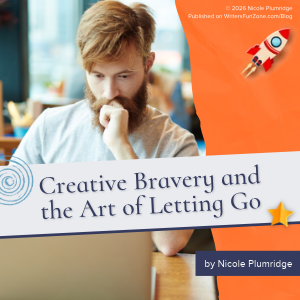 Let’s welcome back Nicole Plumridge as she shares with us “Creative Bravery and the Art of Letting Go.” Enjoy!
***
An Act of Courage
It takes true courage and gumption to put creative work out there.
To expose a layer of yourself, a core part of your identity, for all to witness, examine, pick apart, and judge is no easy feat.
A delicate part of you that was once safely tucked away now exists outside of yourself — outside of your control.
It is little wonder that we get stuck in loops of perfectionism, rewrites, and edits, forever delaying the moment of actually putting ourselves and our creative babies out there.
Cringe is Part of the Creative Process
One of the biggest killers of creativity is self-doubt.
Another feeling that will deliver a swift and potentially fatal blow to creative work is the fear of coming off as cringe.
However, cringe is a part of the creative life — now and always.
There’s almost no getting away from it.
Looking through your creative portfolio over the years is akin to reading old journal entries.
It is hard to read the angsty teenage scribbles filled with what seem like superficial problems.
Immature ramblings punctuated only by doodles of love hearts and wonky stars are strewn across perfume-spritzed pages.
Instead of fading over the years, the scent of embarrassment lingers and strengthens.
The journal entries and past portfolio whisper proof of your creative immaturity.
However, instead of twisting ourselves in knots trying to make ourselves smaller and smaller, perhaps there is another way to view feeling cringe.
Instead of associating cringe with embarrassment and proof of poor work, perhaps cringe can be a marker of success and even — dare I say — pride.
Ultimately, cringe is about seeing your work as less mature than it is now.
Perhaps viewing it as childish.
What could be a better marker of growth than realizing that shift in perspective?
Is there ever a time when we stop growing?
If so, that is the true failure.
If growth implies feelings of embarrassment over past projects, then for as long as you’re growing, you’re bound to feel some degree of cringe.
And if it is inevitable, would it not behoove us to embrace this sentiment rather than do everything we can to flee from it?
No one said growth was easy.
However, growth is what keeps the creative brain alive and thriving.
It needs positive stress and creative stimulation, new problems to solve and new perspectives from which to see the world in order to flourish.
Naturally, as part of that development, old work and projects are bound to feel outdated to the creative.
It is an inevitable part of the process.
Practice Discernment
While some projects may absolutely be for your eyes only, others may be ready for the wider world.
It is the creatives job to discern whether a piece is truly not meant for a larger audience or whether someone or something is silently getting in the way of putting the work out there.
Is fear lingering beneath the surface?
Are anxieties regarding rejection and judgement hovering near your shoulders?
If so, the work may not be the problem.
It is the mind that’s keeping you in a cage.
As a creative, growth not only comes from tinkering with words on the page or mixing paints on a palette.
It comes through feedback, publishing the short story, showcasing the sculptures.
We lose vital growth opportunities if we continue to hoard our work close to our chests for fear of looking silly.
There are worse things in the world than looking a bit silly.
One being never coming out of your creative shell and subsequently not seeing the person you could have become had you taken a risk.
Wasted potential is the quiet tragedy lurking in the shadows of a creative life.
A Question of Resonance
A deeper layer to this creative conundrum is the fear that we may no longer resonate with the pieces we have created.
We catapult ourselves into the future, looking back at our current project through supposedly older, wiser — and more judgmental — eyes.
Yet if we are to take ourselves seriously as a creative, we must do it now, not in twenty years, when we can supposedly be sure of our craft and skill level.
The art is in creating the project, enhancing and elevating it so that it is the best it can be and then letting it go.
Whether we resonate with it or not in ten years’ time isn’t the point.
The truth is, we are ever-evolving beings whilst art is, for the most part, static.
The paint on the canvas dries.
The black and white words encased in the paperback are no longer the fluid characters dancing at your fingertips.
As a result, art can never truly represent us.
All it can do is capture a fraction of our existence and identity in a moment of time.
There is no single piece that can be guaranteed to be a reflection of us over a lifetime.
Instead, we are scrapbooks, adding one page to another, sprinkling glitter over one section, while smudging charcoal over the next.
Perhaps both sections are us.
Perhaps neither are.
Perhaps it does not matter.
Once Published, the Art Isn’t About You
The fear of not resonating with your own artwork is valid.
Not only is it valid, but it has been proven true time and time again.
You have almost certainly come across a short story or essay in your creative bank and inwardly heaved a sigh of relief that the piece did not see the light of day.
The silly poem about the high school crush is thankfully stashed in a folder marked Archive on your desktop.
As mentioned, a level of discernment is necessary in putting your work out there.
However, the problem with self-censorship involving one piece is that it can turn into a pattern, resulting in everything not being good enough.
It must all live up to an impossible standard of satisfying a future version of yourself.
We then become afraid to publish anything.
However, while there is an undeniable fusion between the art and the artist, once the art has developed, a slow partitioning begins to form.
The artist begins to grow in different directions.
The art finds the people it’s meant to.
Perhaps that silly poem that does not resonate with you may yet resonate with another girl, ten years your junior, going through her first breakup.
Perhaps if she had read that poem, it would have moved something in her.
Once you have given birth to the book, the poem, the artwork, and given it legs to stand on, who are we to limit where it explores, who it meets, and the hands it lands in?
Concluding Thoughts
Instead of tying your thoughts in knots over whether the writing is cringe, embarrassing, or whether the future you will resonate with the current piece, you could ask yourself the following questions:
Is it honest?
Is it in integrity with whom I am at this moment?
Did the creation of it change something within me during the process?
If so, maybe it will do the same for someone else.
All we can ask of our art is for it to capture the essence of who we were at the time of creation.
And perhaps that is enough.
***
About The Author
 Nicole Plumridge is a three-time published author whose debut novel became an Amazon bestseller.
Her work has appeared in The Poetryhood and Half-Light Magazine.
She is also a creativity and book coach who supports creatives in building creative practices and reconnecting with their inner magic.
Connect with Nicole and book a discovery call if your creativity is calling you.
Website: https://nicoleplumridgecoaching.com
Instagram: https://www.instagram.com/authornicoleplumridge
LinkedIn: www.linkedin.com/in/nicole-plumridge-39512368
Novels by Nicole:
Healing House: https://www.amazon.com/dp/B08X64LRL3/ref=rdr_ext_tmb
Erosabel: https://rb.gy/ypoyrf
The Ghost You Left Behind: https://rb.gy/72lt0o