Rom-Com Vs Rom-Mystery? Turns Out They Use the Same Skills in Different Costumes by M. Jayne Ladow
 Today we welcome a new guest writer to Writer’s Fun Zone, M. Jayne Ladow who is stopping by to chat with us about “Rom-Com Vs Rom-Mystery? Turns Out They Use the Same Skills in Different Costumes.” Enjoy!
***
For many years, I thought of romantic comedies and mystery suspense romance as two separate muscles.
Write the funny one on Monday, write the tense one on Tuesday, and never let the two touch.
Recently, I mapped out both genres side by side in a Venn diagram — old teacher habits die hard — and realized the overlap wasn’t much larger than I’d imagined.
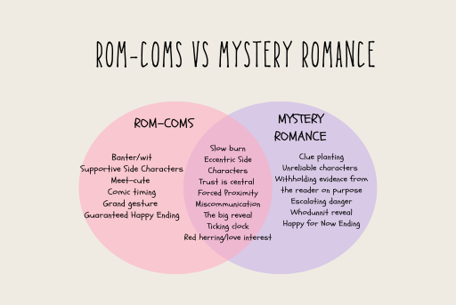 With this chart in hand, I stopped treating funny and suspenseful as opposite settings on a dial and started treating them as the same craft tool, aimed at two different questions: who did it and who do they love?
Withhold and Reveal
Both genres, mystery and romance, run on the same underlying mechanic: control what the reader knows, and when they find it out.
In the game of love, characters are not always honest with themselves or others.
Unspoken fears, insecurities, and personal beliefs feed the conflict. In mystery romance, a character might withhold a fact — a lie, an alibi, a character’s motives.
These characters all have a motive, and the fun becomes trying to untangle these details, motivations, and characters to own up to it.
Knowing the similarity helps me create a will-they-won’t-they arc into the plot.
They aren’t separate skills; you just need to point the same flashlight in a different direction.
Misdirection
Think about the charming suspect in a mystery — the one who’s a little too smooth or helpful, and you can’t tell if that’s suspicious or just his personality.
Now think about the rom-com love interest who seems too good to be true, and the heroine keeps waiting for the catch.
That’s the exact same reader-doubt mechanic.
One resolves with he’s innocent, the other with he’s not playing games, he’s just genuinely great.
Writers build the doubt with identical tools: charm, plus withheld information, plus a reader trained by genre to expect a twist.
This is also where the “red herring/ love interest” trope lives.
Mystery romance and rom-com both love the decoy — the rival suitor, the wrong suspect, the person the reader is led to believe matters more than they do.
It’s misdirection, and writers choose whether the reveal breaks a heart or solves a case.
Forced Proximity
Stakeouts.
Locked-downs.
Shared investigations.
Road trips.
Workplace romance.
Forced proximity is the most reliable trope in both genres because it generates chemistry and suspicion simultaneously.
Why does she keep turning up near the crime scene?
Why can’t he stop noticing her lips when she argues?
You don’t need two different scenes to build tension and romance.
One well-built proximity scene can carry both loads if you let the dialogue do double work: banter that’s also an interrogation, flirtation that’s also information-gathering.
Eccentric Side Characters
Every mystery has the witness who’s clearly holding something back.
Every rom-com has the best friend who is the voice of reason (just talk to him already, Karen).
Interesting side characters play both roles.
In a mystery, they know more than they’re telling.
In a Rom-Com, they sling the truth like shots at a party.
If you’re a mystery author stuck on how to reveal a plot fact naturally, borrow this trick: let it slip out (oops) through banter, deflection, or a joke that lands a little too close to the truth.
The Reveal
This is the trope I think is most underused on purpose: the big reveal in both genres asks the reader to mentally flip back through earlier chapters and see them differently.
The mystery reveal turns clues into evidence with a big a ha moment.
In rom-coms a grand gesture turns banter into “he’s loved her since chapter three.”
If you’re writing mystery romance, you get to do this twice — once for the case, once for the relationship — and the strongest books I’ve read stagger those reveals instead of stacking them on the same page, so neither one steals the other’s air.
The Takeaway
If you’re building a mystery romance or want to give your rom-com some real tension, don’t think of it as juggling two plots.
Map two timelines: a mystery clock and a romance clock — and ask, at every major beat, what’s being withheld on the romance side and suspense side, and who’s suspected of what on each side?
When you can answer both questions at every turning point, you’re not splitting your attention between two genres.
You’re using one skill, pointed in two directions at once.
That’s the whole trick.
Rom-com and mystery romance aren’t cousins who happen to get along.
They’re the same craft skills wearing two different outfits, and once you see the overlap, you’ll never plot either genre the same way again.
Two Mentor Texts for Your Venn Diagram
The Hating Game by Sally Thorne: Banter, comic timing, forced proximity, withhold and reveal, misdirection in an enemies-to-lovers rom-com.
Naked in Death by J.D. Robb: A police procedural running in parallel with a slow-burn romance. Forced proximity, withhold and reveal, misdirection, and eccentric side characters in a romantic mystery.
***
About the Author
 M. Jayne Ladow writes rom-com and mystery romance where banter hides more heat than jokes.
Follow her on TikTok, Instagram, and Facebook @mjayneladowauthor, read more on Substack at mjlong.substack.com, and visit mjladow.com for her full catalog and latest releases.
Freebie
 Get a free copy of my first rom-com, One Night Stands and Lesson Plans.
Audrey Freemont, a professional middle school teacher, hasn’t had time or energy to find romance in five years.
When she sees Oz Taylor at a school happy hour, it’s one look, and they are sneaking out.
But after the one-night stand, reality catches up with them.
He’s the new algebra teacher at Marchfield Middle, and he wants more, but Audrey is caught between the world of expectations for teachers and her desire for more than a workaholic life.