THE DO’S AND DON’TS OF COMMUNICATING WITH ARTISTS FOR YOUR BOOK — From an Artist Herself by Anna Leitensdorfer
 Today we welcome back Anna Leitensdorfer to Writer’s Fun Zone. She is stopping by to chat with us about “THE DO’S AND DON’TS OF COMMUNICATING WITH ARTISTS FOR YOUR BOOK.” Enjoy!
***
Reaching out to an artist can be both exciting and intimidating.
After all, they can turn your written words into book covers, interior art, scene illustrations, and so much more!
So, what are some things to do — and what to steer clear of — when looking for an artist?
DO’S:
1. Research your artist(s).
Make sure their style/their portfolio has elements that you want to see in your finished artwork.
2. Look at an artist’s Terms of Service to see what all is allowed/not allowed.
For example, some artists will not draw heavy machinery or gore or only specialize in one style and one style only.
3. Be polite and courteous.
The artist is most likely just as excited as you are!
In many cases, they are your biggest cheerleaders!
4. Communicate clearly.
When expectations are laid out plainly, the chances of miscommunication or misunderstandings diminish rapidly.
In addition, if an artist sends a revision, the sooner you reply with feedback or “It will take me a few days to figure out what I would like to change”, then the artist knows what is going on/can make those changes.
This also applies if you are out of town/will not be able to communicate for a certain amount of time, so just let your artist know (and give an end date/when you will be back).
5. Keep in touch frequently.
Yes, life happens, but touching base at least once every two weeks or even once a week with the artist while your commission is active is a great way to stay on track and keep misunderstandings at a minimum.
Sometimes artists are so absorbed in their work that they forget to reply and might just need a little reminder.
This also goes for the artist, too.
6. Ask the artist about their workflow.
How do they tackle revisions?
How long does a book cover in their style take on average?
Don’t be afraid to ask questions about how they work!
7. Request a contract if the artist does not provide one.
Contracts are a surefire way to protect you, as the client, and the artist.
Remember to read over any contract you receive carefully before signing and don’t be afraid to ask to make changes to the contract if there are errors.
8. Be clear and concise.
If you get a progress picture and the colors are not what you want, be upfront and let the artist know as soon as possible.
Do not be afraid to request revisions if they are available/part of your commission.
9. Stand up for yourself.
In the event you hire an artist that just isn’t quite working out (such as they are trying to turn the piece into what they want rather than what you want, or they are just not communicating with you), then look at parting ways with them.
Review the contract you signed with them and see if it outlines any policies regarding discontinuation of work.
Sometimes things don’t work out, and that’s okay. It’s just business.
DON’TS:
1. Ask an artist to mimic or copy another artist or another company’s art style.
Many artists have their own unique style, which is what separates them from others.
It’s like asking a film student to directly copy James Cameron’s filming style just because you want James Cameron cinema but can’t get James Cameron.
2. Request a discount on an artwork.
Many artists already undercharge, and some artists are willing to work within your budget.
Come to them with a budget you have set for yourself, and they may be able to work with you.
If they cannot, then resume your search for a new artist, keeping them in mind for the future when you do have the funds.
3. Accuse an artist of tracing or AI-usage without proper evidence.
Baseless accusations can severely hurt an artist’s reputation, even if they are innocent.
If you are suspicious of AI, message a fellow artist friend privately to get their opinion.
4. Tell an artist that they “have the skills to do [this art piece]” that is severely out of the artist’s skill set.
For example, if an artist solely works on organic landscape paintings with not a single spaceship in their portfolio, it is most likely they do not specialize in machinery.
An artist knows their strengths and weaknesses, and while it is okay to try something new, please be respectful and understand that it might be something they have not developed enough skills for yet.
5. Ghost the artist after sending an initial inquiry.
If they are out of your budget, just reply with a “Thank you so much for your time, but this is just out of my budget for right now.”
Artists will follow up with any open leads, so this will let them know not to contact you.
This also applies to artists, as ghosting potential clients can come off as rude as well.
Conclusion
Basically, all that it comes down to when looking — and hiring — an artist is communication.
Be open with what you want and your expectations!
After all, the artists want to make sure they are creating art as close to your vision as possible.
Many of these do’s and don’ts can also apply to other professions, not just art, so they’re nice to keep in mind.
Did any of these do’s or don’ts surprise you?
***
About the Author
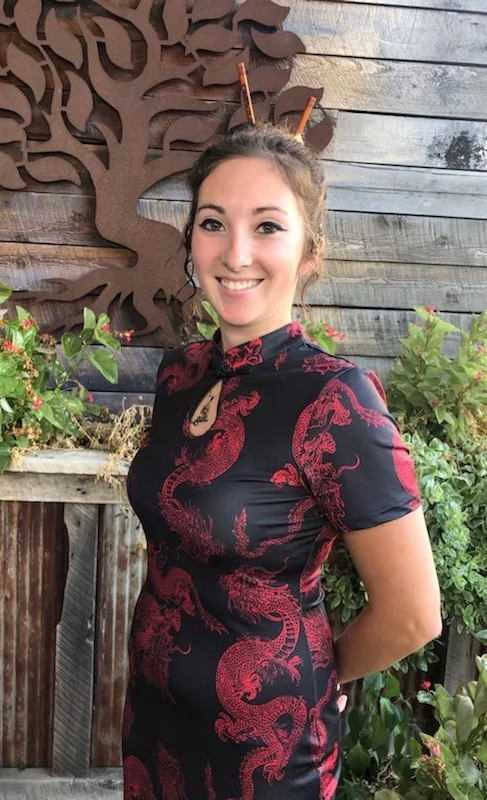 Anna Leitensdorfer is an illustrator, animator, and author who began offering creative services to fellow writers in 2024.
She provides illustration for children’s books, storyboarding, cover design, character art, interior art, maps, and promotional artwork for marketing.
A 2018 graduate of the Savannah College of Art and Design with a degree in Animation, Anna continues to pursue her passion for storytelling through visual media.
She is currently developing her original animated feature film, Art of Auld Lang Syne, while also expanding her work in book design and print formatting.
In addition to supporting other authors, Anna writes her own fiction and recently completed a supernatural horror manuscript.
When she’s not behind her drawing tablet, she can usually be found playing video games or taking her two “little monsters,” Shelby and Percy, bowling.
She is open to commissions in animation, game design, and illustration.