Editing Your Sci-Fi/Fantasy Novel: Genre, Tropes, and Character Arc
Editing Your Sci-Fi/Fantasy Novel: Genre, Tropes, and Character Arc – How To Write the Future podcast, episode 213
***
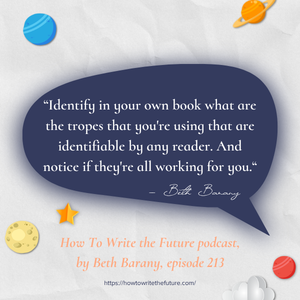
“Identify in your own book what are the tropes that you’re using that are identifiable by any reader. And notice if they’re all working for you.“ – Beth Barany
In this How To Write the Future podcast episode, “Editing Your Sci-Fi/Fantasy Novel: Genre, Tropes, and Character Arc” host Beth Barany explains why the “Edit Your Novel Checklist” is a great resource for writers who have finished their rough draft, encourages you to think about your reader and genre expectations, and provides an example and walk-through of a story showing you how to problem solve issues with your character arc.
This episode also includes discussion of book tropes; how to hone in on the biggest problem in your story; the next stages of your story writing; and whether that stage includes beta readers or an editor.
Platforms the podcast is available on: Apple Podcasts | Buzzsprout | Spotify| YouTube
RESOURCES
Support the podcast! https://ko-fi.com/bethbarany
Get the workbook: https://writersfunzone.com/blog/world-building-resources/
Join the Edit Lab! https://bethbarany.com/editlab
About the How To Write the Future podcast
The How To Write The Future podcast is for science fiction and fantasy writers who want to write positive futures and successfully bring those stories out into the marketplace. Hosted by Beth Barany, science fiction novelist and creativity coach for writers. We cover tips for fiction writers. This podcast is for readers too if you’re at all curious about the future of humanity.
This podcast is for you if you have questions like:
– How do I create a believable world for my science fiction story?
– How do I figure out what’s not working if my story feels flat?
– How do I make my story more interesting and alive?
This podcast is for readers, too, if you’re at all curious about the future of humanity.
Transcript for episode 213 – Editing Your Sci-Fi/Fantasy Novel: Genre, Tropes, and Character Arc
Editing Checklist Next Steps
BETH BARANY: Recently, one of my students in the Edit Lab asked for more clarification about how to edit their manuscript. Now, they already had the Edit Your Novel checklist, which I encourage you to go get, which is a high level review of your book. It encourages you to read your book, and make notes, and score yourself based on all the different parts of editing your novel, from the high level down to story, plot, structure, character development, and even punctuation.
Once you have that score, now what? This is what I think she was asking, now what? How do you dig deeper into editing your novel?
[00:45] Genre And Reader Expectations
I always go back to the starting point, which is what kind of story are you writing? Meaning, what is your genre?
Now, I’m talking to science fiction and fantasy writers. I assume you have a rough understanding of your genre, whether you’re writing science fiction, whether you’re writing fantasy or some kind of, some people call it science magic, or a fantasy, like fantasy romance, fantasy adventure, fantasy mystery.
Same with science fiction. Maybe you’re writing science fiction mysteries, like I do, or science fiction thrillers, which are very popular, or science fiction adventure, or fantasy adventure, which is also very popular, what we might also call epic fantasy. Maybe you’re writing a saga. Maybe you’re writing a cozy science fiction or a cozy fantasy.
So as you can see, I’m talking about genre and subgenre, and what do all these terms mean? They are basically reader expectations. And it goes with trends, we have put names to the kinds of stories we’re talking about
Now, these things are trendy. They change with the times. Some things stand the test of time, and that’s all relative, right? Like, what span of time are we talking about?
[01:57] Tropes And Comp Titles
So for today, for this month, this year, the last few years, look at your genre and sub-genre and sub-sub-genre and see if you can identify what are the tropes.
What are tropes? Tropes are things that reoccur again and again. If I were to tell you that I was writing a story about an orphan going on an adventure to reclaim their throne.
Okay, right away you start to piece all that together and you have a kind of story. I’ve just told you some main elements of that story.
What I haven’t yet told you is the kind of world we’re in, whether it’s a fantasy or a science fiction or a contemporary or historical. So those things can come in some more. Maybe I said there’s a magic sword and a secret pertaining to this orphan’s power, and there were magical pirates and wizards.
Right away, all those things I just said place that story inside of a fantastical world, a fantasy. So when it comes time to think about, well, now, now that I’ve done a high level analysis of my book, how do I figure out what to do next?
And I’m gonna say it again, here’s where you wanna really understand your genre and maybe study and look at the other books in your genre, which are called comps or complementary titles.
Identify in your own book what are the tropes that you’re using that are identifiable by any reader. And notice if they’re all working for you.
[03:40] Fixing The Character Arc
If you have a main character who’s an orphan, which is a very common trope, what is the change arc this orphan is gonna go through?
We all read for character transformation, I believe, in, in the genres, and literary can be a whole other conversation, and that’s not my specialty. So if you have a character who’s an orphan, by the end of the book, we want some kind of resolution to have happen, especially if being an orphan is what drives that character in some way.
So now we’re talking about internal character arc, and this is usually the first place I go when I start editing my story, and also my clients’ stories, is I’m like, is it clear what is the character changing starting at, and then a new place, they’re ending up at? So that’s one thing to look at. Is that change clear? And if it’s not clear, now what? Let’s make it clear at the beginning. I always come back to the beginning of the story. What is their starting point, their starting question? And now we start to get into questions of character development, and really being clear about what this character wants and needs, how they think of themself, how they think of the world, and what, from over here as the author position, the, the God position, do we know they’re missing?
They don’t know necessarily what’s missing. They might feel off or off-kilter in some way, but they don’t know what’s missing. But we as the author do.
[05:11] Wounds Lies And Identity
And some people call that the wound. Some people call that the lie. I don’t like to call it those two things because, well, actually, the wound is good, ’cause we’re often driven by our wounds, and I self-identify with them.
Like I am my wound. And I say we ’cause human beings, right? We base our characters on real people, are walking around with a wound that we identify as who we are. But somewhere deep down, we crave a change, and we crave to identify ourselves in a different way. So for example I am an orphan is an identity.
But what if, and I’m working on a story like this, what if my main character realizes halfway through that they weren’t orphaned by, by, from the beginning, that they actually have parents, and the memories of their parents start to come back to them?
So what if the change arc for my character is at the beginning she thinks, “Oh, I’m just an orphan, and I was in an orphanage, and then I left the orphanage,” and then by the end of the story, what if she’s realizes, well, actually, this big thing, this big tragedy happened, and I was orphaned. I was with my parents and they died because of this big conflict, and actually, I have a heritage that I come from, a lineage, and I can claim the lineage.
Before she doesn’t know her lineage, she just thinks she was p- plucked off the street, and put into the orphanage, but then she finds out later on that she actually has a lineage, and she is not an orphan anymore really. And by the end of the story, she could be thinking about actually, I belong to this long lineage, and who I really am is someone different, and then I, whatever that difference is, I would have her, I’m gonna have her declare that and say, “Oh, I am blah, blah, blah now.
I am a daughter of this lineage,” and I would make it be very specific.
[06:58] Hone In On Biggest Problem
So what I’ve done right now is I’ve honed in on one specific problem to fix in the story. And what I’m often doing in revisions is after I do my analysis and I, ch- check it out, see if this works for you, take the Edit Your Novel Checklist, do your read-through, analyze your story, score yourself, s- your story, and then hone in on the biggest problem.
For me, it’s always a character issue. For some writers, it’s plot. It really depends. You’re gonna have to try if you’re not sure.
[07:33] Beta Readers And Editors
Once you’ve fixed your character arc, and by fixed, I mean you’ve done your brainstorms, you’ve made your notes, you’ve made your changes in your story, now what? At this point, it depends.
Either you’ve taken the story as far as you can go and you’re pretty happy with the plot, you like your new character changes, you’ve cleaned up the manuscript as best you can with char- you know, with, with commas and punctuation and spelling. Now what? The best thing to do, in my opinion, is to start to bring it out to critique partners and beta readers, and maybe hire an editor.
I myself don’t edit manuscripts just by themselves. I actually teach people how to become better editors of their own work, and I do that through my group mastermind for science fiction and fantasy writers. And that is a very small group, and you have to apply to that, and it’s really a place where you learn how to improve as a writer.
So I’m not the kind of person who will take your manuscript, edit it, and hand it back. There’s lots of great other editors out there who can help you with that, and if you need recommendations, just reach out to me. I know a lot of people.
[08:41] Wrap Up And Farewell
So that’s all I’m gonna talk about this week. If this,provoked, evoked any questions for you, let me know so that I can make a new episode on it.
I really believe that editing a novel is a very fruitful and wonderful endeavor, and it really pays for you to understand how to edit your own novel. Even if an editor does it for you, you still have to go in and make decisions. So making those decisions is our work as writers, and I know you can do that.
All right, that’s it for this week, everyone. Write long and prosper. And I hope you enjoyed that little clip with Rocket the Cat. Ciao for now.
Loved this episode? Leave us a review and rating here:
https://www.buzzsprout.com/2012061
Need instructions on how to leave a review? Go here.
***
Support our work for creatives: leave a tip: https://ko-fi.com/bethbarany
***
ABOUT BETH BARANY
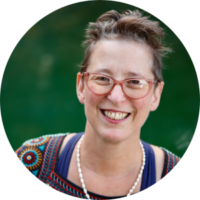
Beth Barany is an award-winning fantasy and science fiction novelist and creativity coach for writers. They help novelists write, revise, and publish stories that matter—blending practical craft guidance with a big-picture commitment to imagination, meaning, and possibility.
Learn more about Beth Barany at these sites:
Author site / Coaching site / School of Fiction / Writer’s Fun Zone blog
CONNECT
Contact Beth: https://writersfunzone.com/blog/podcast/#tve-jump-185b4422580
Email: beth@bethbarany.com
LinkedIn:https://www.linkedin.com/in/bethbarany/
IG: https://www.instagram.com/bethbarany/
TT: https://www.tiktok.com/@bethbarany/
FB: https://www.facebook.com/bethbarany
X: https://twitter.com/BethBarany
CREDITS
- EDITED WITH DESCRIPT: https://www.descript.com?lmref=_w1WCA (Refer-a-Friend link)
- MUSIC CREDITS : Music from Uppbeat (free for Creators!): https://uppbeat.io/t/soundroll/fuzz-buzz License code: UMMKDRL02DFGKJ0L. “Fuzz buzz” by Soundroll. Commercial license: https://musicvine.com/track/soundroll/fuzz-buzz.
- DISTRIBUTED BY BUZZSPROUT: https://www.buzzsprout.com/?referrer_id=1994465 (Refer-a-Friend link)
- SHOW PRODUCTION BY Beth Barany
- SHOW CO-PRODUCTION + NOTES by Kerry-Ann McDade
- EDITORIAL by Iman Llompart
c 2026 BETH BARANY
For more “How To Write the Future” episodes, go here.
If you’d like to invite Beth onto your podcast, drop her a note here.
✅ Like the work we do? Tip us! https://ko-fi.com/bethbarany