How to Convey Backstory for Secondary and Tertiary Characters, How To Write the Future podcast, ep 225
How to Convey Backstory for Secondary and Tertiary Characters, How To Write the Future podcast, episode 225
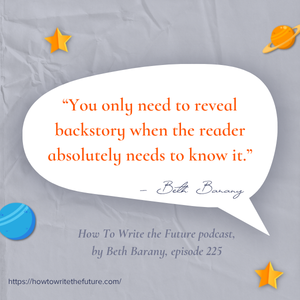
“You only need to reveal backstory when the reader absolutely needs to know it.” – Beth Barany
Do you want to know how to add backstory to your secondary characters without slowing down the main plot and action of your story?
In this How To Write the Future podcast episode titled “How to Convey Backstory for Secondary and Tertiary Characters,” host Beth Barany describes how you can filter backstory through the secondary and tertiary characters and shares tools to reveal the story’s past. Plus, she goes over how to use your characters’ thoughts, feelings and history to help convey the worldbuilding in your story.
There is also an invitation to sign up to Beth’s Edit Lab, a monthly $10 subscription with a monthly call.
Platforms the podcast is available on: Apple Podcasts | Buzzsprout | Spotify| YouTube
RESOURCES
Support the podcast! https://ko-fi.com/bethbarany
Get the workbook: https://writersfunzone.com/blog/world-building-resources/
Join the Edit Lab! https://bethbarany.com/editlab
About the How To Write the Future podcast
The How To Write The Future podcast is for science fiction and fantasy writers who want to write positive futures and successfully bring those stories out into the marketplace. Hosted by Beth Barany, science fiction novelist and creativity coach for writers. We cover tips for fiction writers. This podcast is for readers too if you’re at all curious about the future of humanity.
This podcast is for you if you have questions like:
– How do I create a believable world for my science fiction story?
– How do I figure out what’s not working if my story feels flat?
– How do I make my story more interesting and alive?
This podcast is for readers, too, if you’re at all curious about the future of humanity.
Transcript for episode 225 How to Convey Backstory for Secondary and Tertiary Characters
Welcome and Topic Setup
BETH BARANY: Hey, everyone. Beth Barany here with How to Write the Future podcast. I am coming to you from Oakland, California, across the bay from San Francisco, and I am passionate about writing science fiction and fantasy stories, and I’m passionate about helping writers with theirs.
That’s my whole focus in my writing business.
So today we’re gonna talk about how do you convey backstory for secondary and tertiary characters without slowing down the action, without boring the reader, without getting anyone confused. Now, of course, it is quite a feat. You’re not gonna figure it out right away.
This is usually something people figure out in edits, which is why I run Edit Lab, a monthly teaching and editing call where we go over your words. So everything I share with you today here is gonna hopefully help you, and really, I believe the best way to learn is to get eyes on your own words. So if you’re interested in that, I’ll share a little bit more about that later in the episode.
[01:05] Edit Phase Mindset
Now I’m gonna just jump in and give you some tips that you can use for editing your work. Now, I do recommend that you do this at the edit phase. Do not stress about it in the first drafting phase. That is for writing.
All right. I’m looking at my note. Looking at my note.
Also, so I’m gonna take off my glasses because the glare; I don’t know how to handle the glare.
[01:27] POV Filtered Backstory
So how do we convey the backstory of secondary and tertiary characters in our stories?
Most people here are writing in one point of view, or maybe if you write in other points of view, you might have a section or a chapter for each point-of-view character.
When you’re in your point-of-view character, you still need to describe other characters. The secondary characters, tertiary characters, anyone who crosses your point of view character’s path is someone whose backstory could be revealed.
So the best way to reveal backstory, number one, is it’s entirely filtered by what your point of view character knows, understands, guesses, even if it’s wrong, surmises, has learned somewhere.
Because they’re your guide for the story, you only can convey what they know.
So the other important thing to note is the main character is gonna have some kind of relationship with these other characters. So you need to know what that is, and that will also color what they reveal. Lastly, something to keep in mind that I jokingly tell my clients: share on a need-to-know basis, like we’re spies.
So you only need to reveal backstory when the reader needs to know it, absolutely needs to know it. Without it, things would be confusing. So let’s define some terms.
Backstory, in my mind, is anything that happens before page one to your character, to the other characters, to your story world. And so integrating those into your present, your story present, the story narrative, is what’s key here. We don’t wanna pause the story to do some kind of history dump, and pause the action to do any kind of flashbacks unless, again, it’s absolutely necessary, and it’s part of the reality for your point-of-view character.
Now, the first thing to keep in mind is: what does your main character know about these other characters? And it’s going to be filtered also through the main character’s needs and wants and fears and misunderstandings and biases, and that’s also what makes it interesting.
[03:32] Character Roles and Archetypes
The first thing I like to think about when I come up with who my secondary and tertiary characters are is to be very clear on how this secondary or tertiary character is helping or hindering my main character.
Are they an antagonist? Are they a best friend helper character? Are they a catalyst? Are they a witness? Are they a minor obstacle? Or perhaps they form some other role, like love interest, like mentor, like ally, like threshold guardian. Now, if you’re familiar with archetypes, I just named a bunch of archetypes.
It’s really helpful to start with that so you understand what the point of view character’s relationship is to these other characters, and that will also help you make decisions on what to reveal and what they wouldn’t know.
[04:23] Need to Know Exposition
So as I said, you wanna reveal backstory on a need-to-know basis.
The real test here is the reader gonna understand this without any context?
If you’re starting a story, they don’t know the story. You need to add little tiny tidbits. You need to add a little tiny bit of exposition, which is information that the main character would know about their world.
They’re acting like a little bit of an explainer to the reader, but you do it in a way that is completely in the point of view character’s voice and entirely based on what they would actually know. Maybe you need to explain an action, like maybe the main character is guessing at the motivation of another’s action. That’s always helpful.
Maybe the main character is noticing that the secondary or tertiary character is doing something that they need to respond to, and in that way, we can also learn something about the past of the secondary or tertiary character. Or what they do and the explanation of it by the main point of view character is gonna deepen the story world.
[05:25] Tools for Revealing Past
So on a practical level as a writer, what are your tools? In your toolkit you have dialogue, you have description, you have action, you have implying or subtext, you have the main character having a memory, and you also have their internal experience, their interiority, their thoughts and feelings. These are all the ways that you can convey another character’s backstory.
[05:49] Speculation and Expectations
So another thing that is so fun to play with is expectations. The main character, and also the reader, will have expectations about a kind of character that shows up maybe looking and acting like a pirate until suddenly they don’t, and then that can make the main character wonder or guess, like maybe they’re more than a pirate.
Maybe there’re, there’s something else about them. And they can speculate.
One of the biggest problems I see in my clients’ manuscripts is they don’t use the tool of playing with speculation. We all have guesses and wonderings about each other in the real world. Bring that into your fiction. Your point of view character is not just describing the world or having thoughts and feelings that relate to themselves.
They’re gonna have expectations and guesses about the other people.
[06:41] World-building Through Others
And that is so much fun to play with. Now also, a secondary character, through their own dialogue, through their own action, through something they provoke in your main character, they also can be revealing a little bit about their past that will directly relate to your story world.
And it can reveal so many things about the story world. It can reveal culture, power, status, conflict, social expectations through the way a secondary character or tertiary character will respond to your main character.
So here’s a little exercise for you to do, is to describe, in two to three adjectives, a secondary character from your main point-of-view character’s perspective.
Write down their name. What is their expected story role? And given that, what is your main character, and even the readers, expecting will be the outcome of this character in the story? And then you can also play with, because of that, what things might happen to your secondary character, good or bad, again, through the point of view character’s eyes.
In what way will the secondary or tertiary character break expectations, create some kind of contradiction, make us surprised, and also teach us something about the story world? When we write in science fiction and fantasy, it is our job to provide context, and the way to provide context is often through what other characters in the story do and say.
So now we get some kind of context of the culture. And remember, everybody filters science fiction and fantasy through what they know about the contemporary world.
[08:21] Language and Terminology Tips
So we have to be skillful about using contemporary references in a way that do not take us out of the story world. So, for example, just one small example from one of my clients in a recent edit lab class: they used a phrase that lacked a few words to give us context.
They used the phrase “birth form,” which could imply “baby”. But really what they’re talking about is gender. So we were asking them to say the ” original gender form” or something like that. So that could convey that this was about the fact that people had different genders throughout their lives, at least some characters did.
So when you are playing with trying to share new concepts that no one has ever heard of, you have to play with language until you find the terminology that readers will associate with what you’re trying to accomplish. And this is really hard to do on your own.
[09:19] Edit Lab and Programs
This is why I recommend people get critique partners or hire editors, uh, or join groups like mine. I have an edit lab at $10 a month. I told you I would tell you about that. You’re welcome to join. We have our monthly call on the first Wednesday of the month at 10:00 AM Pacific, 1:00 PM Eastern.
And then if you are ready for some intensive work on your novel, I have a 12-month program, the Edit Mastermind for science fiction and fantasy writers. Both these groups are for science fiction and fantasy writers, and I recommend that you contact me if you’re curious about that. Enrollment for that will be opening soon.
[09:54] Wrap Up and Resources
So I hope that this was helpful today give you some ideas on how to convey backstory for your secondary and tertiary characters.
If you have any questions about this or backstory, be sure to check out my resources. I’ve done a lot of episodes on backstory, so check out the resources section of this podcast so you can see what I’ve done and find some resources for you.
So be sure to check out my episode on where to insert backstory, episode 113, and that link is in the show notes. And I also have an article on my blog, Writer’s Fun Zone blog: “Three Powerful Techniques to Weave Backstory into Your Novel.”
I hope to see you in our edit lab or edit mastermind.
If you have any questions about backstory, let me know.
And if you’d like to join us in either of these, be sure to follow the links in the resource section, or just reach out to me directly.
That’s it for this week, everyone. Write long and prosper.
Loved this episode? Leave us a review and rating here:
https://www.buzzsprout.com/2012061
Need instructions on how to leave a review? Go here.
***
Support our work for creatives: leave a tip: https://ko-fi.com/bethbarany
***
ABOUT BETH BARANY

Beth Barany is an award-winning fantasy and science fiction novelist and creativity coach for writers. They help novelists write, revise, and publish stories that matter—blending practical craft guidance with a big-picture commitment to imagination, meaning, and possibility.
Learn more about Beth Barany at these sites:
Author site / Coaching site / School of Fiction / Writer’s Fun Zone blog
TConnect with Beth Barany
Twitter: https://twitter.com/BethBarany
LinkedIn: https://www.linkedin.com/in/bethbarany/
Email: Beth@BethBarany.com
CREDITS
- EDITED WITH DESCRIPT: https://www.descript.com?lmref=_w1WCA (Refer-a-Friend link)
- MUSIC CREDITS : Music from Uppbeat (free for Creators!): https://uppbeat.io/t/soundroll/fuzz-buzz License code: UMMKDRL02DFGKJ0L. “Fuzz buzz” by Soundroll. Commercial license: https://musicvine.com/track/soundroll/fuzz-buzz.
- DISTRIBUTED BY BUZZSPROUT: https://www.buzzsprout.com/?referrer_id=1994465 (Refer-a-Friend link)
- SHOW PRODUCTION BY Beth Barany
- SHOW CO-PRODUCTION + NOTES by Kerry-Ann McDade
- EDITORIAL by Iman Llompart
2026 BETH BARANY
For more “How To Write the Future” episodes, go here.
If you’d like to invite Beth onto your podcast, drop her a note here.
✅ Like the work we do? Tip us! https://ko-fi.com/bethbarany