How To Use Notion AI for Developmental Editing
How To Use Notion AI for Developmental Editing – How To Write the Future podcast, episode 212
***
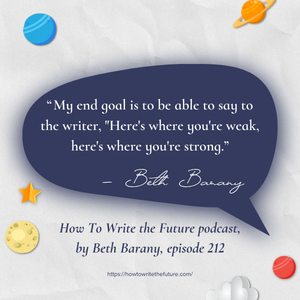
“ My end goal is to be able to say to the writer, “Here’s where you’re weak, here’s where you’re strong.” – Beth Barany
In this forward thinking How To Write the Future episode, titled “How To Use Notion AI for Developmental Editing” host Beth Barany shares how authors can use AI ethically to help them in their writing, explains how she uses Notion AI for her clients, and includes a detailed work-through and the step-by-step analysis of how it works.
Platforms the podcast is available on: Apple Podcasts | Buzzsprout | Spotify| YouTube
RESOURCES
JOIN: For fiction writers! You’ve finished your first draft! Congrats! Now what?
Join the Future-Ready Writer membership and get premium weekly lessons and a monthly Q&A on Zoom. Subscribe: https://www.buzzsprout.com/2012061/subscribe
FREE: Sign up here to get your World Building Workbook for Fiction Writers
Overwhelmed by world-building for your sci-fi/fantasy novel? Use these prompts to brainstorm your story’s world: https://writersfunzone.com/blog/world-building-resources/
SHOP**: Sci‑Fi & Fantasy 24 Writing Prompts:** https://ko-fi.com/s/4ac9160a74
Want to be interviewed on the podcast? => Email us!
FOR CREATIVE WRITING PROFESSIONALS – BUILD YOUR BUSINESS SERVING WRITERS
Sign up to be notified when our training opens and get a short Creative Business Style Quiz to help you create success.
https://bethbarany.com/apprenticeship/
Support our work for creatives!
Buy me a coffee: https://ko-fi.com/bethbarany
GET SUPPORT FOR YOUR FICTION WRITING BY A NOVELIST AND WRITING TEACHER AND COACH
Schedule an exploratory call here and see if Beth can support you today: https://writersfunzone.com/blog/discovery-call/
About the How To Write the Future podcast
The How To Write The Future podcast is for science fiction and fantasy writers who want to write positive futures and successfully bring those stories out into the marketplace. Hosted by Beth Barany, science fiction novelist and creativity coach for writers. We cover tips for fiction writers. This podcast is for readers too if you’re at all curious about the future of humanity.
This podcast is for you if you have questions like:
– How do I create a believable world for my science fiction story?
– How do I figure out what’s not working if my story feels flat?
– How do I make my story more interesting and alive?
This podcast is for readers, too, if you’re at all curious about the future of humanity.
Transcript for Privacy‑First AI for Developmental Editing (Without Uploading Your Draft)
Why This AI Episode
BETH BARANY: So I was recently talking with an author of mine who really liked this process I made for her using AI tools. And then also, another client of mine asked me, ” How is AI impacting your life?” I’m like, ” Oh my God, that’s such a big question.”
So I thought I would devote today’s episode to talking about the way I’m using AI specifically to help writers.
I understand there are writers out there who are categorically opposed to using any of these AI tools. This episode is not for you. This episode is for people who are curious about how to use AI tools and do it in an ethical way, and actually have it be helpful.
[00:50] Meet Beth Barany
So hi, everyone, I’m Beth Barany. I run How to Write the Future podcast. I’m your host and guide. I am a creativity coach and writer, writing teacher. I write science fiction and fantasy. I’m here to share tips, share my wisdom, share my point of view, and help you walk away with something useful.
Also, I really believe that our stories can help us reshape who we are as human beings. And so with that light, let’s dive into today’s episode about how AI can actually benefit you as a writer.
[01:25] The Editing Project
So I work with novelists, and I have one use case to share with you today. And that is I spent, gosh, a year, maybe more, working with this author, going through her chapters and offering up comments and edits. And then she would send it back to me with questions and changes, and then I would answer back with more comments, and I would also say, “Hey, good job here,” and answering her questions.
So about half her book, we did two rounds of edits, and then the second half of her book, I think we just did so far one round of edits. And when I speak about edits, in this case, we are staying in the realm of developmental edits. There was very few line edits in this this round. It was a first pass on her novel, and it was developmental edits. About character, about story, about plot, about world-building.
Okay, so there we are. We’re done. Whew. It’s took us some time to get through all of this, and because we were doing it over time in small chunks. She is a client of mine in the group mastermind program where she gets a monthly call with me, and I edit her book monthly.
And we did it, actually, we broke it into smaller pieces, and so in any given month, maybe I was looking at a piece of her novel every week. Sometimes twice a week. We just cut it into really small chunks so that it was easier to deal with. So every chapter has six parts, which was fine with me. I’m flexible.
[02:55] The Real Problem
So I had all of this material and tons of comments, 36 chapters. I touched her manuscript, nine times in every chapter. And that is what I needed to get analyzed.
My end goal was: how can I analyze and compile all of my comments?
Let’s look at the trends. What are the trends? What are her weak areas, and what are her strong areas?
Now, I knew intuitively that this was a great use case for using AI tools because this is what they’re good at. They’re good at compiling a whole lot of information and summarizing it.
[03:26] Privacy First Approach
But I wanted to do it in a way that I did not feed her book into ChatGPT or Claude or whatever.
I didn’t want her book to go into one of these engines at all. It… So I’m like, “But I still wanna use the tools, and I know they can shortcut this for me.” So here’s what I did.
[03:46] Notion AI Solution
I worked with Notion AI, Notion’s AI, and I pay for that. That’s the only place I pay f- to have access to the souped-up version, uh, the AI tools.
Not the free tools, but the paid tools. And AI, Notion, I believe, uses a combination of a few different…I think they use Anthropic, Claude’s Anthropic, and I think they use ChatGPT, OpenAI’s ChatGPT. I could be wrong. If I am, it’s gonna be in the show notes, so don’t worry.
What’s important here is I told Notion what are my restrictions. I said, “I don’t wanna feed this book into an, into an LLM,” a large language model, which are used to build these tools. “What I want is to have you compil- or have a tool like you compile all my comments in a way that’s organized so we could see what’s going on in the prologue, chapter one, chapter two, etcetera, all the way to chapter 36.”
So I said, “What are my options?” I actually asked it to tell me all the options, and it gave me a bunch of options. A lot of them I eliminated because they were either feeding it into the LLM or too complicated or had too many steps. And honestly, I can’t remember what they are, but I can tell you what the solution is. What we came up with, which suited what I was already used to.
Notion is a land of databases, and I have already been working with different databases, so I knew their value.
[05:11] Building The Macro
What I ended up doing is having Notion write a macro for me that I loaded into Microsoft Word. Now, I have the lightest understanding of macros. They’re essentially code that are like shortcuts that can do multiple steps in a push of a button.
I understood the concept. So I worked with Notion’s AI to build a macro, and I, because I don’t read code, it wrote the code for me, but, and because I could read it but not understand it, I asked it to tell me what it does. And I went through that very carefully, what it doesn’t do, and it asked me questions, and I answered them, and it, I had it build this macro.
Then I tested it. I followed the instructions how to load the macro into Microsoft Word so I could use it anytime I wanted to. So I tested it, seemed to work fine.
[06:03] Workflow In Action
Here’s what I do now. Is I organize the chapter, I compile all the parts of the chapter. For example, I was looking at chapter three.
There’s 24 parts, and some of those are her things that she sent to me, and I can easily see what they are, and then some of it, half of it is my notes to her.
So I calculated. There’s 12 Word documents in chapter three that I want analyzed. So I open up each one, hit the macro button. It outputs for me a CSV file, a spreadsheet file. When I have all of those, I upload them into Notion. It creates a database. I don’t really, I don’t read the database. I ask Notion AI to read the database, and I’ve already told it what I want. I want it to compile a summary.
That’s my end goal. My end goal is to be able to say to the writer, “Here’s where you’re weak, here’s where you’re strong,” and, for chapter three.
And then eventually, I will have her strengths and weaknesses compiled for every chapter, and then I will do a macro analysis.
For every step of this analysis, I’m basically having Notions AI summarize my comments and put them into a readable format. Short paragraphs with bullet points, with subheaders. That’s it.
[07:20] Why It Works
I think this is a good use of AI. This is very detailed left-brained work that I’m not excellent at. I’m excellent at the emotional intuitive work, but also I understand story structure and I understand how to build a good story. So my comments to her are structural and also character-oriented.
And I’m thinking of how is the reader gonna relate to this? Is this interesting? Is it captivating? Does it grab me? And again, only on the story level and on the character level, not yet on the sentence level. Take a deep breath. This is what AI is good for. It’s compiling a whole bunch of information and organizing it.
[08:03] Ethical Tips And Wrap
So I encourage you to to play with this. You could develop your own macro. I would definitely support your desire not to feed your book into any of the AI tools because then they get to… it’s, they’re gonna take it, and it’s, if it’s connected to the master, databases, it could be used. You know, if you don’t check the right button, they could be training off of your data.
So if you don’t want them to do that, then go ahead and find a workaround. So this was my workaround. The writer is so grateful. She gets to see a summary with bullet points. It is so useful. So let me know, in the comments or write me what you think of this use case. If you’ve come up with any other use cases that both protect the privacy of the writer and of your own writing and help you, like a writer’s assistant, and help you in ways that maybe you’re weak and you’re strong over here and it’s helping you over there.
All right. So that’s it for this week, everyone. Write long and prosper.
Loved this episode? Leave us a review and rating here:
https://www.buzzsprout.com/2012061
Need instructions on how to leave a review? Go here.
***
Support our work for creatives: leave a tip: https://ko-fi.com/bethbarany
***
ABOUT BETH BARANY

Beth Barany is an award-winning fantasy and science fiction novelist and creativity coach for writers. They help novelists write, revise, and publish stories that matter—blending practical craft guidance with a big-picture commitment to imagination, meaning, and possibility.
Learn more about Beth Barany at these sites:
Author site / Coaching site / School of Fiction / Writer’s Fun Zone blog
CONNECT
Contact Beth: https://writersfunzone.com/blog/podcast/#tve-jump-185b4422580
Email: beth@bethbarany.com
LinkedIn:https://www.linkedin.com/in/bethbarany/
IG: https://www.instagram.com/bethbarany/
TT: https://www.tiktok.com/@bethbarany/
FB: https://www.facebook.com/bethbarany
X: https://twitter.com/BethBarany
CREDITS
- EDITED WITH DESCRIPT: https://www.descript.com?lmref=_w1WCA (Refer-a-Friend link)
- MUSIC CREDITS : Music from Uppbeat (free for Creators!): https://uppbeat.io/t/soundroll/fuzz-buzz License code: UMMKDRL02DFGKJ0L. “Fuzz buzz” by Soundroll. Commercial license: https://musicvine.com/track/soundroll/fuzz-buzz.
- DISTRIBUTED BY BUZZSPROUT: https://www.buzzsprout.com/?referrer_id=1994465 (Refer-a-Friend link)
- SHOW PRODUCTION BY Beth Barany
- SHOW CO-PRODUCTION + NOTES by Kerry-Ann McDade
- EDITORIAL by Iman Llompart
c 2026 BETH BARANY
For more “How To Write the Future” episodes, go here.
If you’d like to invite Beth onto your podcast, drop her a note here.
✅ Like the work we do? Tip us! https://ko-fi.com/bethbarany