Writing Consistently: Facts and Myths
Writing Consistently: Facts and Myths – How To Write the Future podcast, episode 184
***
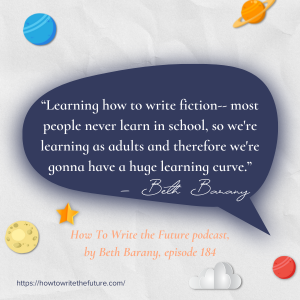
“Learning how to write fiction– most people never learn in school, so we’re learning as adults and therefore we’re gonna have a huge learning curve.” – Beth Barany
In this How to Write the Future podcast episode, “Writing Consistently: Facts and Myths,” host Beth Barany shares the common misconceptions about writing consistently, plus tips on how to find the rhythm of writing that suits and works for your writing style and a bit about her own writing journey.
Platforms the podcast is available on: Apple Podcasts | Buzzsprout | Spotify| YouTube
RESOURCES
FOR CREATIVE WRITING PROFESSIONALS – BUILD YOUR BUSINESS SERVING WRITERS
Sign up to be notified when our training opens and get a short Creative Business Style Quiz to help you create success.
https://bethbarany.com/apprenticeship/
Support our work for creatives!
Buy me a coffee: https://ko-fi.com/bethbarany
GET HELP WITH YOUR WORLD BUILDING – START HERE
Free World Building Workbook for Fiction Writers: https://writersfunzone.com/blog/world-building-resources/
GET SOME FREE WRITING COACHING LIVE ON THE PODCAST
Sign up for the 30-minute Story Success Clinic with Beth Barany: https://writersfunzone.com/blog/story-success-clinic/
GET SUPPORT FOR YOUR FICTION WRITING BY A NOVELIST AND WRITING TEACHER AND COACH
Schedule an exploratory call here and see if Beth can support you today: https://writersfunzone.com/blog/discovery-call/
About the How To Write the Future podcast
The How To Write The Future podcast is for science fiction and fantasy writers who want to write positive futures and successfully bring those stories out into the marketplace. Hosted by Beth Barany, science fiction novelist and creativity coach for writers. We cover tips for fiction writers.This podcast is for readers too if you’re at all curious about the future of humanity.
This podcast is for you if you have questions like:
– How do I create a believable world for my science fiction story?
– How do I figure out what’s not working if my story feels flat?
– How do I make my story more interesting and alive?
This podcast is for readers, too, if you’re at all curious about the future of humanity.
Transcript for episode 184 – Writing Consistently: Facts and Myths
Introduction to Consistent Writing
BETH BARANY: Today I want to talk about writing consistently. Clients have repeatedly told me that they want to write consistently. Comes up a lot. I totally get it. To get a book done, we need to be able to write over a period of time. Makes sense. And same with editing. We need to be able to edit over a period of time.
Being a novelist is definitely the long game. It’s a marathon. So learning how to develop a consistent writing practice is key.
[00:32] Misconceptions About Writing Consistently
But there are some misconceptions I see a lot of writers have, and I wanna see if I can debunk a few of those today.
So, hi everyone. I’m Beth Barany. I run the How to Write the Future podcast and I am a writing teacher and creativity coach with an expertise in helping science fiction and fantasy writers go from idea or seedling of an idea all the way to published book that they are super proud about.
And I also run this podcast because I’m passionate about using fiction and using our art to help reshape the world with our visions about how we could be in the world.
Stories are so important.
So I get it. We all want to develop a consistent writing practice.
[01:18] Beth Barany’s Writing Journey
I certainly did when I first started writing, as an adult. I did it unconsciously as a kid, but as an adult, I was like, how do I do this thing called be a writer?
And so part of the challenge is separating what you think a writer is from what it is that you actually wanna do.
So I’m definitely having my coaching hat on today because it is not a one size fits all recipe. Your consistent writing is gonna look different from another person’s. So I wanna use myself as an example.
When I first started writing fiction, I wrote once a week. And by so doing, I wrote my first full length novel. Now, it did take me five years, and that had nothing to do with the fact that I only wrote once a week because I actually sped up my writing process as I got more confident. It had a lot to do with learning all of it.
[02:12] Most People Never Learn How To Write Fiction in School as Kids
Learning how to write fiction– most people never learn in school, so we’re learning as adults and therefore we’re gonna have a huge learning curve.
So learning how to do it is gonna involve lots of trial and error, and it probably won’t be writing every day at first. It’s really gonna depend on your background, uh, training, skills, everything.
And I came from journalism and being a, a good student and loving being a student, and I still could only manage one week a day at one day a week at the beginning with a guide. I used this fabulous book, called The Weekend Novelist, which as a starter writer, was a wonderful guide. There’s a lot of great starter guides out there.
If you want another recommendation, I’m gonna recommend my own book, Plan Your Novel Like A Pro, which is really about planning your novel and I have other tools for writing. The other book I have that can help you develop a writing practice is my other book, The Writer’s Adventure Guide.
[03:13] Finding Your Own Writing Rhythm
So in terms of writing consistently, get very, very clear on what you want that to be.
Now you may be trying to compare yourself to stories you’ve heard of other writers about what they do.
And I could tell you there’s just as many patterns of writing consistently as are human beings on the planet. I mean, I’ve met writers who only write in the evening, late at night. I’ve met writers who only write first thing in the morning, very early in the morning.
There’s even a group called the 5:00 AM Writers that you can find online and meet up with them if that’s your thing.
There are writers who only work on the weekend and that makes them happy.
Then there’s people like my husband, Ezra. He can write anytime, any place. It’s amazing. He doesn’t seem to be connected to a time of day or location.
And then me. I need to write, right after lunch. That’s my preference. and I write about four days a week to six days a week. And that’s the way it is. And there’s sometimes periods where I’m not writing and I’m okay with that.
And by writing I actually mean working on your book in whatever form. That could look like writing words. It could be editing, it could be research, it could be brainstorming. It could be working on backstory. If you are focused on your book, to me that’s writing. So looking out the window does also qualify.
So first off, really get clear on what writing consistently means to you.
[04:41] Accountability and Community Support
When I asked one of my clients, uh, they said, I write 500 words a day every day, and that is what they are doing, and having a coach in that case helps this person very much because they know someone is gonna look at their work and help them with questions.
Some people join writing sprints. We all also offer writing sprints once a week for an hour in our community. So sign up for the newsletter or sign up for the World Building Workbook, uh, that I offer, uh, in the show notes and you will get invited to that.
Other people use Discord. I have friends who use that. I don’t use it at all, and I have other friends who need to get on a Zoom call every day. In fact, one of my clients does that with an international group of writers and gets on a Zoom call every day that she wants to be writing, which is about four to five days a week.
[05:33] What do you need to write consistently? Accountability, for one
To write consistently, you may need some things that you may not realize, which is you may need accountability, you may need body doubling, meaning you may need to actually sit with other writers, either in person or online.You may also need just one person that you report back to after the fact.
And for accountability, that can look all kinds of ways. I just cited a bunch. But you could also use, if you’re busy on social media, you can use social media to report in. And there are tons of groups. I know on Facebook there are groups, and I’m sure in other social media channels, there are groups where you can show up and say, Hey, I’m gonna write, and then you go away, and then you come back after a time and tell them that you’ve written.
So pay attention if you need accountability and find ways to build that into your life.
[06:23] Resources for finding writing groups
There are many, many resources out there. You’re welcome to reach out to me if you have trouble finding resources. I love helping people find resources. Another place to find resources is meetup.com, and there are groups like Write Now or Shut Up and Write where you can go and be in person with writers if you need that.
Or maybe you just need to be in a critique group where you know someone’s gonna read your pages. That’s a part of accountability as well.
[06:49] The Writers That Succeed Do This
The writers that succeed and write consistently build accountability into their process. Whether they know someone will read their first draft when they’re done, whether they have someone reading pages as they go, whether they’re in a class or a peer group, or work with a coach or an editor.
There are a lot of ways that writers use to be writing consistently.
I, myself, have been in a critique group for, gosh, twenty years, and I love it because it helps me come back to my work because my critique partners are waiting for it.
[07:25] Setting Clear Writing Goals
Another thing that really helps writers write consistently is to get really clear on the goals, and this works well when you’re working on your first draft.
Are you writing a short story or a novella or a novel?
What is your estimated word count goal?
And then work backwards. One of my clients calls this Book Math.
If you wanna write a 50,000 word novel, like National Novel Writing Month proposed and you wanna do it in one month, then do the math, right? That’s 1666.7 words per day for thirty days. Or if you wanna write a 50,000 word novel over the course of a year, then you can just do the math on that.
So if, for example, you wanted to write a 50,000 word novel over the course of one year, three hundred and sixty five days, and you wanted to write every day, that’s 136.9 words. Let’s just round it up, 137 words per day.
So whatever consistency you wanted to get it done, like I’ve written, uh, first drafts, they’re about 50,000 words, I would write them in six weeks because that’s what I could sustain and still have all my other commitments happening, so that’s about averaging about 1100 words per day. Is that right? Let me check my math.
Yeah, so that’s 1,190 words per day but I don’t write every day, so some days would be 1000 words, other days would be 2000 words. A few days might be 3000 words, and that’s how I would do it. So to write consistently just means having a regular rhythm that you can maintain. And it’s at your pace. So you decide.
[09:11] Conclusion and Final Tips
I would love to hear what writing consistently means to you. And if you need resources on being accountable and helping you move forward, feel free. Please do join our list. We have our weekly sprints. We also have a Facebook group where you could come in and announce that you’re writing.Or maybe you just want to tag me on the socials and say, Hey, I’m writing.
Please do that. I am here to support your writing success.
All right, everyone. That’s it for this week. Write long and prosper.
Loved this episode? Leave us a review and rating here: https://www.buzzsprout.com/2012061
Need instructions on how to leave a review? Go here.
***
Support our work for creatives: leave a tip: https://ko-fi.com/bethbarany
***
ABOUT BETH BARANY

Beth Barany teaches science fiction and fantasy novelists how to write, edit, and publish their books as a coach, teacher, consultant, and developmental editor. She’s an award-winning fantasy and science fiction novelist and runs the podcast, “How To Write The Future.”
Learn more about Beth Barany at these sites:
Author site / Coaching site / School of Fiction / Writer’s Fun Zone blog
CONNECT
Contact Beth: https://writersfunzone.com/blog/podcast/#tve-jump-185b4422580
Email: beth@bethbarany.com
LinkedIn:https://www.linkedin.com/in/bethbarany/
IG: https://www.instagram.com/bethbarany/
TT: https://www.tiktok.com/@bethbarany/
FB: https://www.facebook.com/bethbarany
X: https://twitter.com/BethBarany
CREDITS
- EDITED WITH DESCRIPT: https://www.descript.com?lmref=_w1WCA (Refer-a-Friend link)
- MUSIC CREDITS : Music from Uppbeat (free for Creators!): https://uppbeat.io/t/soundroll/fuzz-buzz License code: UMMKDRL02DFGKJ0L. “Fuzz buzz” by Soundroll. Commercial license: https://musicvine.com/track/soundroll/fuzz-buzz.
- DISTRIBUTED BY BUZZSPROUT: https://www.buzzsprout.com/?referrer_id=1994465 (Refer-a-Friend link)
- SHOW PRODUCTION BY Beth Barany
- SHOW CO-PRODUCTION + NOTES by Kerry-Ann McDade
2025 BETH BARANY
For more “How To Write the Future” episodes, go here.
If you’d like to invite Beth onto your podcast, drop her a note here.
✅ Like the work we do? Tip us! https://ko-fi.com/bethbarany