Edit Your Novel Checklist: First Read, No Edits
Edit Your Novel Checklist: First Read, No Edits
***
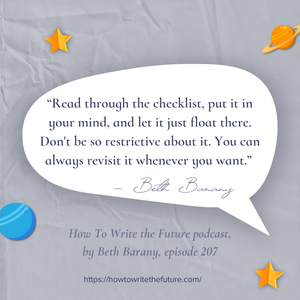
“Read through the checklist, put it in your mind, and let it just float there. Don’t be so restrictive about it. You can always revisit it whenever you want.” – Beth Barany
In this episode of How To Write The Future, Beth Barany walks you through the first step of revision: the first read-through, with no editing.
You’ll learn how to use the Edit Your Novel Checklist as a simple guide for reading your draft like a reader, so you can spot what’s working, what’s unclear, and what you want to revise next.
Titled “Edit Your Novel Checklist: First Read, No Edits,” this episode helps you choose the best way to read your manuscript, decide how much distance you need from the draft, and capture observations without getting pulled into fixing sentences too soon.
Be sure to get your Edit Your Novel Checklist here: https://bethbarany.com/eyncklst.
Platforms the podcast is available on: Apple Podcasts | Buzzsprout | Spotify| YouTube
RESOURCES
JOIN: For fiction writers! You’ve finished your first draft! Congrats! Now what?
Join the Future-Ready Writer membership and get premium weekly lessons and a monthly Q&A on Zoom. Subscribe: https://www.buzzsprout.com/2012061/subscribe
FREE: Sign up here to get your World Building Workbook for Fiction Writers
Overwhelmed by world-building for your sci-fi/fantasy novel? Use these prompts to brainstorm your story’s world: https://writersfunzone.com/blog/world-building-resources/
SHOP**: Sci‑Fi & Fantasy 24 Writing Prompts:** https://ko-fi.com/s/4ac9160a74
Want to be interviewed on the podcast? => Email us!
FOR CREATIVE WRITING PROFESSIONALS – BUILD YOUR BUSINESS SERVING WRITERS
Sign up to be notified when our training opens and get a short Creative Business Style Quiz to help you create success.
https://bethbarany.com/apprenticeship/
Support our work for creatives!
Buy me a coffee: https://ko-fi.com/bethbarany
GET SOME FREE WRITING COACHING LIVE ON THE PODCAST
Sign up for the 30-minute Story Success Clinic with Beth Barany: https://writersfunzone.com/blog/story-success-clinic/
GET SUPPORT FOR YOUR FICTION WRITING BY A NOVELIST AND WRITING TEACHER AND COACH
Schedule an exploratory call here and see if Beth can support you today: https://writersfunzone.com/blog/discovery-call/
About the How To Write the Future podcast
The How To Write The Future podcast is for science fiction and fantasy writers who want to write positive futures and successfully bring those stories out into the marketplace. Hosted by Beth Barany, science fiction novelist and creativity coach for writers. We cover tips for fiction writers. This podcast is for readers too if you’re at all curious about the future of humanity.
This podcast is for you if you have questions like:
– How do I create a believable world for my science fiction story?
– How do I figure out what’s not working if my story feels flat?
– How do I make my story more interesting and alive?
This podcast is for readers, too, if you’re at all curious about the future of humanity.
Transcript for Edit Your Novel Checklist: First Read, No Edits
Introduction
BETH BARANY: Hey, everyone. Welcome to How to Write the Future podcast. I’m your host, Beth Barany, and this is a special episode because this is an episode that I released for my premium members of the Edit the Future Sci-Fi/Fantasy Revision Lab, and I realized, you know what? I want everyone to have this because I invite all of you to come and do the Edit Your Novel checklist, so everyone needs to have the explainer.
So I recorded this explainer for the membership, but I also have it for you here.
If you’re curious about joining the Edit the Future Sci-Fi/Fantasy Revision Lab, or as one of my members called it, Edit Lab, be sure to sign up for the checklist, and you’ll learn all about it.
So that’s all I’m gonna say here. Enjoy the walkthrough through the checklist. Be sure to sign up to get your own so you can stop the confusion and start with the clarity. And have a step-by-step process for editing your novel. Enjoy.
[01:03] Getting the Checklist
Today I am going to go through the Edit Your Novel Checklist to walk you through it.
So if you don’t already have the checklist, be sure to get it at edit your novel checklist.com.
Alright, so once you sign up for the edit your novel checklist, you’ll be jumped over to a Google Doc that you can copy and put on your Google Drive. Download. Make it your own.
It’s editable, so you can, of course, make any changes that you want to the document. This is a working, living document, so use it, even print it out and, and put it with your writing materials. Put it on the wall. This is for you to use.
[01:46] First Read No Editing
So number one, you want to decide how you wanna read your manuscript.
The edit your novel checklist is designed to be a reference document as you do your very first read through of your first draft. Your rough draft. Your discovery draft, however you wanna call it. And if you’ve never done this before, or even if you have, take a moment and think about how you wanna read through your manuscript.
The point is not to make any edits. The point is to read it as a reader, meaning you might need some distance from the time you wrote it, a week, a month, a year. Really, there’s no hard and fast rule on how much distance you need from your manuscript. But what I’ve noticed is that writers need like a cooling-off period, so that they can read their whole manuscript the way a reader would.
That’s the goal. You wanna have some distance, and you wanna have some curiosity. Oh, what is this thing I wrote?
Some technical things that can help you do that is you can either print it out so it’s on paper, or you could send it to your Kindle, iPad or another reading device, so it feels like you’re reading it like a reader would. Put on a tablet or put it on a different kind of computer screen or in a different kind of font.
There are some people I know who will have Microsoft Word read the manuscript to them. That’s an option as well. Whatever works for you. So choose how you want to read through your manuscript. Great.
Once you have decided that, what I recommend is number one: read through this checklist. It’s short. It’s like four pages long, all totalled — three pages of checklist, one page of instruction.
Read through the checklist, put it in your mind, and let it just float there. Don’t be restrictive about it. You can always revisit it whenever you want.
Your goal in this read-through is to pay attention to whatever jumps out at you as incorrect. Maybe it makes you uncomfortable for some reason. Maybe you find your attention waning, moving away, or you’re like, ugh, lemme check email. Let me play my games. Those are points to just notice. Put a question mark on the manuscript. Put a check mark. Put a sticky note, but you’re not editing. Please do not edit your manuscript right now.
You’re just reading it through so you can get a lay of the land; so you can get a big picture; so you can notice maybe the things that you don’t like, but also the things that you do like.
[04:13] Reading Methods and Notes
So just real quick, when I go through my manuscript for the first time, I like to put it onto my Kindle. It’s a little black and white, gray-scale Kindle, and that way, it’s not easy to make fixes. So I’m not tempted to make fixes, and I just make mental notes of what I wanna change. Granted, I’ve been doing this a long time, but I’ll even write them down in my notebook or, in Scrivener, where I keep all my story notes.
Ezra, my co-teacher and husband, and also a writer, he likes to print out the manuscript. He likes to write in the margins, circle things, and sometimes he will put the manuscript on his iPad and read it aloud to himself to find typos, clunky sentences. He does that, actually, when he is really certain the manuscript is pretty clean.
So you don’t have to stick to one way of reading through your manuscript. You can change it up.
[05:05] Know Your Genre
Third piece of preparation, you need to know your genre. Just make your best guess. I’m inviting in people who are science fiction and fantasy writers. We can also call that speculative fiction, right? That’s the broad umbrella term. And inside of that lives science fiction, lives fantasy, lives horror, lives science fiction romance, fantasy adventure romance.
Let’s see. Spicy romantic fantasy, all kinds of things, right?
So you decide what is your genre for now, make your best guess. Maybe it’s a mashup. Awesome, I love that. And just write it down on the checklist, just so you can keep it in mind, because I’m gonna be asking you questions for as you go through your checklist.
So remember, at this stage, do not edit your work. Just make notes in the margins or on sticky notes or in Scrivener, or on a notepad. Use track changes, although that’s kind of starting to push it. Uh, but if that is fun for you and easy, do that. We’re looking for fun. We’re looking for easy, and we’re looking for you to read your book as a reader, so as much as possible. So whatever supports that. Because I repeat, you’re not making changes or fixes or rewrites, none of that. You’re just reading to notice strengths and weaknesses, what’s working and what’s not working.
That’s your job in this read-through.
And this big picture evaluation will help you get, get a big picture of how your manuscript is doing.
[06:35] Checklist Overview
So there’s three main parts of this checklist. The first part is about the story, the plot, what happens.
The second part is about character.
And the third, I call proofing, but it’s not like final proofing. It’s just all the dibby dabby things, grammar, punctuation, that kind of thing, because most likely you’re gonna notice those things in this first read through. So I have made a checklist section for that as well.
[07:04] Story and Plot Checks
So let’s start at the top with story and plot.
Emotional Pacing: Does the story move at the right pace for the emotions you want to convey? Or does it move too slowly or too quickly?
Plot Pacing: Based on your genre, how is the balance of dialogue and action?
Story Logic: Are there gaps in story logic or in the actions of the characters? Can you follow the flow of action from one moment to the next?
Act Structure: Act 1, 2, 3, etcetera. Does your story have a compelling beginning, rising action, complications?
And then closing resolution as appropriate for your genre. Does it start in the right place? Have enough action in the middle, have a satisfying ending?
Scenes: Do your individual scenes start and end at the best point of interest for you? Does each scene have a compelling beginning, rising action and complications, and closing resolution?
And then Reader Expectations: Do you meet reader expectations for your genre for plot and pacing? Do you surprise the reader and yet fit the genre?
[08:11] Character Checks
Alright.
Our second section on character: Goal, Motivation, Conflict, or GMC. Do your characters have clear goals? Clear reasons, motivation for their actions, and goals. Do they have conflict, preventing them from reaching their goals?
Point of View: Do you stay in one character’s point of view per scene?
Setting: Is the setting conveyed from the point of view character? Is the information shared relevant to the story’s tone and moment?
Dialogue: Does the dialogue sound different for each character? And some more questions on dialogue. Does the dialogue move the action forward or enhance character, or is it appropriate for the pacing of the moment, such as to lighten the mood, for example?
Consistency: Does the character stay in character?
And lastly, for this section, Readers’ Expectations: Do your characters behave as your readers expect they would for your genre?
[09:14] Proofing Checks
And then the third section.
Proofing / Grammar: Do you keep the story in the tense you’ve chosen?
Punctuation: Is your punctuation correct and consistent, given your artistic purposes and genre conventions?
Word usage: Are you using specific nouns and verbs versus vague nouns and verbs? Are you using emotionally charged adjectives as appropriate for your genre?
Spelling: Is your spelling correct and consistent for your artistic purposes and genre conventions?
Metaphor: Do you use metaphor and simile to convey emotion rooted in the point of view of the character?
And lastly, on the checklist, Reader Expectations: Is your book clear of errors in a way that makes the reading easy and clear for readers of your genre?
So that is the Edit Your Novel Checklist.
Hope you found it helpful. Be sure to grab your own checklist at EditYourNovelChecklist.com.
[10:13] Scoring and Next Steps
Once you have gone through your manuscript and read the entire thing and made notes using the Edit Your Novel Checklist, now it’s time to score all the elements.
Simply on a scale from one to five, one being needs the least work and five being needs the most work. Go through every element on your checklist and give it a number.
Just number it from one to five, and you can do granularly on every single element in the three sections. The story and plot section, the character section, and the proofing section.
And once you’re done. If you feel like it’s fun to do, go ahead and add up your score. That will give you an overall sense of how much work you need to do.
Don’t let this number intimidate you. This is just information, just helping you understand where you feel you are in your manuscript.
[11:11] Wrap Up and Farewell
Alright, that’s it for this week, everyone.
Happy editing, and connect with you in the next episode.
Write long and prosper.
Loved this episode? Leave us a review and rating here:
https://www.buzzsprout.com/2012061
Need instructions on how to leave a review? Go here.
***
Support our work for creatives: leave a tip: https://ko-fi.com/bethbarany
***
ABOUT BETH BARANY
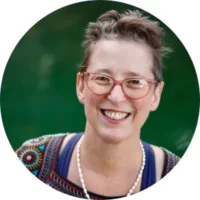
Beth Barany is an award-winning fantasy and science fiction novelist and creativity coach for writers. They help novelists write, revise, and publish stories that matter—blending practical craft guidance with a big-picture commitment to imagination, meaning, and possibility.
Learn more about Beth Barany at these sites:
Author site / Coaching site / School of Fiction / Writer’s Fun Zone blog
CONNECT
Contact Beth: https://writersfunzone.com/blog/podcast/#tve-jump-185b4422580
Email: beth@bethbarany.com
LinkedIn:https://www.linkedin.com/in/bethbarany/
IG: https://www.instagram.com/bethbarany/
TT: https://www.tiktok.com/@bethbarany/
FB: https://www.facebook.com/bethbarany
X: https://twitter.com/BethBarany
CREDITS
- EDITED WITH DESCRIPT: https://www.descript.com?lmref=_w1WCA (Refer-a-Friend link)
- MUSIC CREDITS : Music from Uppbeat (free for Creators!): https://uppbeat.io/t/soundroll/fuzz-buzz License code: UMMKDRL02DFGKJ0L. “Fuzz buzz” by Soundroll. Commercial license: https://musicvine.com/track/soundroll/fuzz-buzz.
- DISTRIBUTED BY BUZZSPROUT: https://www.buzzsprout.com/?referrer_id=1994465 (Refer-a-Friend link)
- SHOW PRODUCTION BY Beth Barany
- SHOW CO-PRODUCTION + NOTES by Kerry-Ann McDade
c 2026 BETH BARANY
For more “How To Write the Future” episodes, go here.
If you’d like to invite Beth onto your podcast, drop her a note here.
✅ Like the work we do? Tip us! https://ko-fi.com/bethbarany