Business Advice Creatives Can Actually Use
Business Advice Creatives Can Actually Use – How To Write the Future podcast, episode 197
***
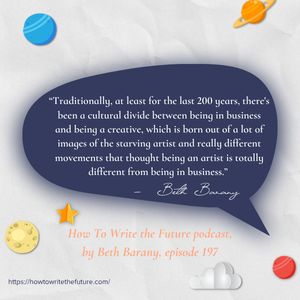
“Traditionally, at least for the last 200 years, there’s been a cultural divide between being in business and being a creative, which is born out of a lot of images of the starving artist and really different movements that thought being an artist is totally different from being in business.” – Beth Barany
In this How To Write the Future podcast episode titled “Business Advice Creatives Can Actually Use” host Beth Barany shares business advice for creative entrepreneurs and creative writers. From pitching your work, filtering advice that suits you, as well as Beth sharing an early business struggle of hers, this episode will inspire you to get creative in your marketing.
Platforms the podcast is available on: Apple Podcasts | Buzzsprout | Spotify| YouTube
RESOURCES
FOR CREATIVE WRITING PROFESSIONALS – BUILD YOUR BUSINESS SERVING WRITERS
Sign up to be notified when our training opens and get a short Creative Business Style Quiz to help you create success.
https://bethbarany.com/apprenticeship/
Risk Taking Without Desperation: Write From Trust
https://writersfunzone.com/blog/2026/03/02/risk-taking-without-desperation-write-from-trust/
Support our work for creatives!
Buy me a coffee: https://ko-fi.com/bethbarany
GET HELP WITH YOUR WORLD BUILDING – START HERE
Free World Building Workbook for Fiction Writers: https://writersfunzone.com/blog/world-building-resources/
GET SOME FREE WRITING COACHING LIVE ON THE PODCAST
Sign up for the 30-minute Story Success Clinic with Beth Barany: https://writersfunzone.com/blog/story-success-clinic/
GET SUPPORT FOR YOUR FICTION WRITING BY A NOVELIST AND WRITING TEACHER AND COACH
Schedule an exploratory call here and see if Beth can support you today: https://writersfunzone.com/blog/discovery-call/
About the How To Write the Future podcast
The How To Write The Future podcast is for science fiction and fantasy writers who want to write positive futures and successfully bring those stories out into the marketplace. Hosted by Beth Barany, science fiction novelist and creativity coach for writers. We cover tips for fiction writers. This podcast is for readers, too if you’re at all curious about the future of humanity.
This podcast is for you if you have questions like:
– How do I create a believable world for my science fiction story?
– How do I figure out what’s not working if my story feels flat?
– How do I make my story more interesting and alive?
This podcast is for readers, too, if you’re at all curious about the future of humanity.
Transcript for episode 197 – Business Advice Creatives Can Actually Use
Business Advice Disclaimer
BETH BARANY: Hi everyone. You are not a one-size-fits-all person, and nor should the advice that you bring in. If you feel like this advice doesn’t fit you, then throw it out. Today I wanna talk about business advice for creative entrepreneurs and creative writers. I understand creative writers, you may not think of yourself as a business, and that is totally okay, but if you wanna be publishing your books, then you need to be understanding some of the elements of business.
And if the word business makes you cringe, then maybe this episode is not for you. And that’s totally fine.
[00:38] Creatives and Business
Hi, everyone. I’m Beth Barany. I run How to Write the Future Podcast, and I have a YouTube channel, so if you’re watching this on YouTube, welcome.
I am growing my YouTube channel this year. So excited to do that.
Traditionally, at least for the last, gosh, 200 years, there’s been a cultural divide between being in business and being a creative, which is born out of a lot of images of the starving artist and, and really different movements that thought being an artist is totally different from being in business.
But actually, Leonardo da Vinci had to go and pitch his work to get commissions. Artists have always had to pitch their work to get commissions. Artists have always had to showcase and learn how to talk about what we do. I think it’s just in the recent past that there’s been such a strong divide between being in, in business and being a creative, and by recent past, I mean about the last 200 years.
Now, of course, I’m generalizing, so please take what you know of history and add some salt to that.
I definitely did grow up in an artistic family that really separated being in business, making money, from being creative, and they were like anathema to each other.
My artist family just didn’t seem to focus a whole lot, at least not consciously, on the marketing, although I did see marketing happening, which was awesome because every artist, every creative writer, every, any creative, playwright, dancer, filmmaker, we all need to market our work. So being in business is really about saying, Hey, everyone, I have this awesome thing for sale.
And learning how to communicate that in a way that has value for the people that you’re talking to.
[02:20] My Early Business Struggle
Lemme say this. When I first started my business 20 years ago, I looked around, and I asked some creative writers who are also running their own businesses, like editors or graphic designers, things like that.
I’m like, can you please gimme some advice around running a business? And so I talked to them and I interviewed them, and I recorded it, and I was coming at it with my journalist hat and I got a lot of information, but none of it felt right for me, and I was very disappointed. No fault of their own, they brought me what they knew, but they were all coming from a business perspective, purely business perspective, numbers, making money, profit ledgers, which it’s all important to understand. It’s important to learn budgeting. I’m finally like getting my hands around budgeting in a deep way.
I’m constantly learning in my business. I don’t have it all figured out and, they didn’t talk to this thing that I really cared about, which is I wanna run a business, but I wanna also be a writer. I’m not giving up on creative writing. When I opened my business 20 years ago, I had not yet published any fiction or even, I had published journalist articles as a journalist, but I had never published fiction.
And I think I maybe had one little story that had been published actually years previous when I was in college, in a little tiny newsletter, which was awesome. But that’s it. And then my articles, my nonfiction articles.
But I had been working as a writer. I mean, I had been working on my writing. I was a novelist. I think I was on my third novel by then.
So they weren’t speaking at all to how do you be a creative, come from that creative place of intuition and trusting yourself and taking risks. You can listen to my other episode on risks, and I’ll put that link in the show notes, but nobody really was speaking to being a creative soul who is running a business. And even today, when I go out into the literature, I rarely find there’s a little bit out there, but not very much about this.
[04:10] Filtering Others Advice
So what does this mean for you? Any kind of business advice is obviously gonna be rooted, grounded in that other person’s experience.
And like my experience is not the same as your experience. And where I came from and how I was raised and all my training isn’t gonna be the same as yours. So when we hear other people’s business advice, we have to realize we don’t actually come from the same place. So how do we sift through that business advice?
Something I did learn over the years, and hearing lots of repetitive, oh, everyone is saying this, and everyone is saying that, like, okay. Some of those things, if we boil it down to their fundamental concern. Okay, let me understand that from my perspective. So, for example, I understand as a creative writer, I write novels, and I spend a lot of time, like in the cave, writing novels separate from others.
Then I start bringing it out for beta readers, critique partners, and editors and all of that. I start entering the marketplace. So first, a lot of. Especially writers, we tend to create on our own, or maybe you have a writing partner. We tend to create on our own with our writing tools, and then we start inching forward into the marketplace, testing our art.
Are you changing your story because of what everyone says? Maybe a little bit, but you still have to sift it through yourself. And I talked about receiving feedback in a, in a previous episode, so I’ll put that link in the show notes too. How do we handle all the feedback we get?
[05:34] What Business Really Means
My point here today is that a fundamental of being in business is that you actually have something to sell.
You have a product, like a book, or you have a service like a coach, or a teacher,or a trainer, or, um, an assistant. Or you have products or workbooks, courses, trainings, being in business, meaning is about having something to sell. And learning how to sell it in a way that your audience can understand, and also meets a need that they have.
[06:02] The Needs We’re Meeting as Fiction Writers and Service Providers
In fiction writing, what need are we meeting? We’re meeting the need for entertainment, the need for escape, but it’s also deeper than that, and I teach science fiction and fantasy writers how to market their work. What can you say that really meets the need?
The reader is reaching out for books. Ooh, they want to read some new things, and you as the author, like, here, I have a new thing for you. And it’s like this. And you say some words about what it’s like, and there’s a match.
Same with marketing, a service or a product as a creative entrepreneur, as a creative writing teacher or coach, or virtual assistant, or maybe you design books or you produce books for people. There’s a lot of ways to serve writers. So your job, as you hear all the advice out there, is to filter it through what feels right for you. And there’s an element of risk, which I mentioned in the risk episode, where you might wanna, what is your appetite for risk? What can you test? What can you try?
[06:59] No One Right Way
Now, when I hear business advice, I try and think about, well, where are they coming from? Are they coming from purely talking about let’s make money, which doesn’t include anything about like my personal, one’s, personal thoughts and feelings, and and emotions and body awareness, whether or not this advice is right for me.
Some people just throw advice at you and they say, you gotta do it. You gotta do it ’cause if you don’t do it, you’re not in business. And actually, I question that.
Being in business is about bringing your product to market and inviting people to buy it, and bringing your service to market, inviting people to buy it.
Other than that, there’s a million and one ways we can do that, and things are constantly shifting in the world– technology, culture, everything like that. So ultimately, there is no one right way, I think, to be in business other than to create this um, playground ’cause to me, I see it as like, create a safe space where you can do that, where you can bring your product to market.
Now, should you trust what I have to say? No. Bring it through your own filter, your own personality, your own life experience. Not everybody’s advice is gonna be right for you, including mine.
All right.
[08:05] Wrap Up and Bootcamp
Uh, I just wanna let you know we are running a Creative Entrepreneur bootcamp in March called Find Your Creative Entrepreneur Niche. We’re gonna help you narrow down, bringing together your strengths, helping you have clarity, giving you some structure, and giving you some feedback.
Go ahead and register for that using the link in the show notes.
And be sure to take our quiz. Our creative business style quiz so you can understand what is actually your approach to business. It’s gonna really help you filter other people’s business advice.
Alright, that’s it for this week, everyone. Take care and write long and prosper.
Loved this episode? Leave us a review and rating here:
https://www.buzzsprout.com/2012061
Need instructions on how to leave a review? Go here.
***
Support our work for creatives: leave a tip: https://ko-fi.com/bethbarany
***
ABOUT BETH BARANY
Beth Barany teaches science fiction and fantasy novelists how to write, edit, and publish their books as a coach, teacher, consultant, and developmental editor. She’s an award-winning fantasy and science fiction novelist and runs the podcast, “How To Write The Future.”
Learn more about Beth Barany at these sites:
Author site / Coaching site / School of Fiction / Writer’s Fun Zone blog
CONNECT
Contact Beth: https://writersfunzone.com/blog/podcast/#tve-jump-185b4422580
Email: beth@bethbarany.com
LinkedIn:https://www.linkedin.com/in/bethbarany/
IG: https://www.instagram.com/bethbarany/
TT: https://www.tiktok.com/@bethbarany/
FB: https://www.facebook.com/bethbarany
X: https://twitter.com/BethBarany
CREDITS
- EDITED WITH DESCRIPT: https://www.descript.com?lmref=_w1WCA (Refer-a-Friend link)
- MUSIC CREDITS : Music from Uppbeat (free for Creators!): https://uppbeat.io/t/soundroll/fuzz-buzz License code: UMMKDRL02DFGKJ0L. “Fuzz buzz” by Soundroll. Commercial license: https://musicvine.com/track/soundroll/fuzz-buzz.
- DISTRIBUTED BY BUZZSPROUT: https://www.buzzsprout.com/?referrer_id=1994465 (Refer-a-Friend link)
- SHOW PRODUCTION BY Beth Barany
- SHOW CO-PRODUCTION + NOTES by Kerry-Ann McDade
c 2026 BETH BARANY
For more “How To Write the Future” episodes, go here.
If you’d like to invite Beth onto your podcast, drop her a note here.
✅ Like the work we do? Tip us! https://ko-fi.com/bethbarany