Creativity as Strategy: Lessons from Khafre Jay
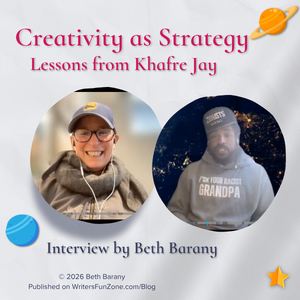 Your creativity can be your strategy, your compass to fulfillment, service, and income? Jump in to this interview with Khafre Jay, founder of Hip Hop for the Future.
***
Recently I had the pleasure of sitting down with Khafre Jay, an artist, educator, and community builder whose work keeps circling back to one core idea: creativity isn’t fluff. It’s a tool for survival, agency, and real-world change.
We covered a lot in 34 minutes (including music, business models, community spaces, and the messy realities of making culture sustainable). (I’ll be sharing another conversation we had back in February soon on the How To Write The Future podcast.)
What I want to share here — especially for my fellow creative writers — is what Khafre kept returning to: make what fits you, make it specific, and make it useful.
Who Khafre Jay is (and why writers should pay attention)
Khafre doesn’t talk about creativity as a vague “follow your dreams” slogan. He talks about it like a strategist.
At one point he described a workshop he created for college students who don’t see themselves reflected in the traditional pipeline:
“It basically centers on taking your identity, your culture, something that you’re passionate about, and trying to imagine that as a job, as a business, as a company… What would that look like…?”
Even if you’re not trying to build a nonprofit or run community programs, that mindset is gold for writers.
Because the same question applies to us:
- What do you care about enough to keep returning to it?
- What do you already do naturally (even when you’re tired)?
- How do you shape that into stories, offers, teaching, or services that actually fit your life?
Khafre’s advice for creatives: start with what you love
When I asked what he would say to a working novelist trying to translate skills into service, Khafre went straight to energy and alignment:
“First off, what skill are you the most excited about? What skill do you love the most? It has to be self-fulfilling.”
Then he added a twist I appreciate because it’s honest:
“I really disagree highly with [‘Do something you love and you’ll never work a day in your life.’]… I think if you find something you love, [you’ll] work your fingers to the bone if you’re not careful.”
That’s real. Loving something doesn’t magically remove effort. But it does change the emotional math—especially over the long haul.
For writers, this can be a relief. It means you don’t need permission to lean into what you genuinely love (themes, settings, obsessions, questions, subgenres). You can treat that love as data. A compass.
A practical framework writers can borrow
Khafre offered a concrete way to narrow the field when you have many interests:
“Pick the top five things that you like to do and imagine which one you think will be the easiest… take the least amount of input, effort, [and] will be the most rewarding… And do that one first… because really it’s just order of operations.”
Writers often get stuck because we have too many valid paths:
- Which book next?
- Which marketing strategy?
- Which platform?
- Should I teach? freelance? self-publish? query?
This “top five + easiest-rewarding-first” approach isn’t about shrinking your ambition. It’s about reducing friction so you can keep moving.
Niche isn’t a cage. It’s a power move.
Khafre’s examples were vivid (and delightfully weird in the best way). He talked about taking a passion and letting it shape both business and art:
“Some people think of just painting and how do I get out there… Some people think, ‘Hey, I’m going to make my own gallery.’ … It becomes fulfilling.”
And then he brought it directly into storytelling:
“If they like pottery, write a mystery novel about pottery… there’s shards of pottery with little cuneiform codes on it…”
Later he doubled down on the same idea with another example:
“If you’re a novelist and you like knitting… make a crime novel that has to do with yarn… Make a sci-fi space knitting…”
I’m sharing these not because you need to write “space knitting” (though honestly, if you do, please send me the link). I’m sharing them because Khafre’s point is bigger:
- Your specific interests are not distractions.
- They can be the very thing that differentiates your work.
- They can create a demand you didn’t realize existed.
Creativity as resilience (and why it matters right now)
Early in our conversation, Khafre said something that stuck with me:
“Creativity is the only thing that is going to get our minds out of this kind of sleepiness.”
If you’ve been writing (or trying to) in the middle of anxious times, you know what I mean. Sitting down to write can feel like an act of reclaiming.
Creativity doesn’t ignore reality. It gives us language, shape, and meaning-making. And for many of us, it’s one of the few places we can still choose our attention.
One more craft gem: voice through embodiment and repetition
As a writer and teacher, I’m always listening for process details—the “how do you actually do it?” part.
Khafre described a method he uses to write raps while driving: no paper, building line by line, repeating until it locks in. What struck me wasn’t just the memorization—it was how embodied it is. Rhythm, tone, melody, syllables. He said:
“You’re not just writing the words, you’re writing the tones… the syncopation.”
Writers can borrow this by experimenting with:
- Reading scenes out loud (yes, really)
- Repeating a paragraph until the cadence is right
- Letting voice emerge through sound, not just meaning
What I’m taking with me (and what I hope you take too)
Khafre’s overall message to writers is beautifully simple:
“I don’t think anything’s too crazy. [I] just think that we’re crazy to try things that don’t fit us perfectly. It’s a waste of time.”
So here’s your Writer’s Fun Zone invitation, straight from that spirit:
- Name what you love.
- Make your weirdness specific.
- Choose the next step with the best effort-to-reward ratio.
- Build stories (and a creative life) that actually fit you.
That’s not just craft advice. It’s creative strategy.
About Khafre Jay
Khafre Jay is a Bay Area hip-hop educator, organizer, and public health advocate who builds welcoming cultural spaces where people can get on the mic, be heard, and grow.
His work centers on turning creativity into a practical strategy for survival, community care, and leadership, especially for Black youth and other students who’ve been told they don’t “fit” inside traditional systems.
Khafre brings a deep love of rap craft (voice, rhythm, memory, performance) alongside a fierce commitment to making spaces that are rooted in peace, love, unity, and accountability — spaces where people can start, experiment, and get better without being shamed.
Khafre is focused on creating and sustaining Flow Lab: free, consistent, community-based open mic and rap-writing spaces that keep hip-hop culture alive and accessible, and that help artists build real momentum — and real income — over time.
He also hosts a Sunday radio show on KPOO (12-3pm PT) highlighting local Bay Area hip-hop artists, and partners with community organizations to bring hip-hop into public health and family-support spaces.
All the details about his hip-hop events at HipHopForTheFuture.com.
How to support Hip Hop for the Future: (Yes, I am a supporter.)
Monthly gifts power recurring programs that produce measurable outcomes: paid artist fees, weekly artist incubators, and public-health events that deliver screenings and resources. Join their Culture Keepers at $10/month (or whatever you can give) and turn cultural credibility into community results.
Hip Hop for the Future Events
FloLab (weekly in Berkeley)
FloLab is a weekly rap-writing contest and open mic cypher focused on building skills, courage, and community. The night begins with an open mic to warm up and encourage people to step up, and then moves into the contest — artists perform what they wrote to the beats and the crowd chooses who advances. The winner takes home a $300 cash prize. Flow Lab is designed to push back on the misconception that rap spaces are automatically harsh or humiliating; the vibe is rooted in support, growth, and cultural respect.
SF Pregnancy Village (monthly in San Francisco)
Khafre Jay partners with SF Pregnancy Village, a community event held on the second Saturday at the Bayview YMCA (Hunters Point, San Francisco). It’s a space for connection, community support, and collaboration with local organizations (including partners like Rafiki Coalition.)
Sunday radio show on KPOO (San Francisco)
Khafre hosts a Sunday hip-hop show on KPOO 89.5 FM (streaming online), featuring three hours of local Bay Area hip-hop artists. It’s a platform for community voices and a way to stay connected to what’s happening right now in the Bay’s music culture.
***
Article by Beth Barany (award-winning science fiction and fantasy novelist, creative entrepreneur, writing coach, creativity coach, writing teacher, and bookish business strategist)
*Note: This post was created with the assistance of Notion’s AI and Canva.
- Get Your Edit Your Novel checklist to go from “What do I do now that my manuscript is done?” to being proud to holding your published novel in your hands! Congrats!
- Take the Creative Business Style Quiz if you’re thinking about starting a bookish business.