How A Character’s Breathing Reveals Their Emotion in Your Novel | How To Write the Future, Ep 217
How A Character’s Breathing Reveals Their Emotion in Your Novel – How To Write the Future podcast, episode 217
***
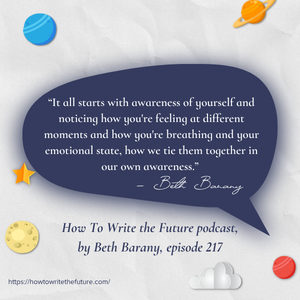
“It all starts with awareness of yourself and noticing how you’re feeling at different moments and how you’re breathing and your emotional state, how we tie them together in our own awareness.” – Beth Barany
Did you know the five senses play an important part in making a connection between your character and readers?
In this How To Write the Future podcast episode, titled “How A Character’s Breathing Reveals Their Emotion in Your Novel” host Beth Barany shares how you can create a deep emotional bond between your characters and readers, when to use breath and emotion cues, and provides writing examples in prose using breath as a technique to hook your readers.
Beth also shares the inspiration behind the episode and shares about her Edit lab, a monthly membership with exclusive perks.
Platforms the podcast is available on: Apple Podcasts | Buzzsprout | Spotify| YouTube
RESOURCES
You finished your novel? Now what? Get the 30,000-foot view with our Edit Your Novel Checklist: http://edityournovelchecklist.com/
Get the workbook: https://writersfunzone.com/blog/world-building-resources/
Join the Edit Lab! https://bethbarany.com/editlab
Support the podcast! https://ko-fi.com/bethbarany
About the How To Write the Future podcast
The How To Write The Future podcast is for science fiction and fantasy writers who want to write positive futures and successfully bring those stories out into the marketplace. Hosted by Beth Barany, science fiction novelist and creativity coach for writers. We cover tips for fiction writers. This podcast is for readers too if you’re at all curious about the future of humanity.
This podcast is for you if you have questions like:
- How do I create a believable world for my science fiction story?
- How do I figure out what’s not working if my story feels flat?
- How do I make my story more interesting and alive?
This podcast is for readers too if you’re at all curious about the future of humanity.
Transcript for episode 217 – How A Character’s Breathing Reveals Their Emotion in Your Novel
Why Body Senses Matter
BETH BARANY: In this episode, I am going to help you translate some body senses and body sensations into your prose. One of the biggest mistakes I see as a writing teacher, a coach, and editor of science fiction and fantasy writers is that the human component is missing. And one of the biggest ways to help the reader experience your story is to put into your story body senses.
So today, I’m gonna talk about a few of those body senses, and actually, I have an entire class on this. And I go into greater depth in my edit lab, my monthly membership, which I’ll tell you about toward the end. All right. Let’s get started.
[00:48] Meet Beth Barany
Hi, everyone. I’m Beth Barany. I am a writing teacher and coach, award-winning science fiction and fantasy writer, and creative entrepreneur.
I have this podcast ’cause I really believe that with know how and understanding and practice, you too can be a science fiction and fantasy writer. And I deeply believe that our stories have deep impact on our readers for entertainment, of course, but also for transformation. So let’s use our power of storytelling for good and help transform the world.
All right. Let’s get started.
So in today’s episode, we are going to talk about breathing. And in future episodes, I am going to talk about some other senses that I see really powerful in our stories. Smell, proprioception, which is our body’s ability to sense itself and where it is in space, and sound. So stay tuned for those.
[01:49] Episode Roadmap
Okay, first off, readers will stay hooked into your stories for longer, wanna keep reading, and wanna read your next book if you can create a strong emotional bond between the reader and the characters. One of the ways you do that is by layering in sensory detail.
As I said, to we’re gonna talk about breathing.
[02:11] Breathing Awareness Basics
We’re always breathing all the time. That is the hallmark of being alive. So there are multiple components to being able to bring sensory details into your fiction. The first one is to start noticing these elements in yourself, and your only job is to bring up to conscious awareness these senses. In future episodes we’ll cover some more, and in our edit lab we go into greater depth as well, especially through actual line edits.
So breathing. Notice your own breathing. Most of the time, we don’t notice our breathing. Most of the time it’s below conscious awareness, which is great. We need that. Our body is great at doing most things below conscious awareness. So you’re not gonna affect your breathing, you just wanna notice your breathing, and notice how your breathing is when you’re calm.
There’s nothing to write home about.
[03:04] Breath and Emotion Cues
Now notice what happens when you’re surprised. Often people take an intake of breath. Or notice what happens when you’re frustrated. People sigh, and they, like, push their breath out. Notice what happens if people are panicked. I’m not gonna replicate that. I don’t wanna…If I try and breathe quickly, I’m going to make myself feel panicked.
Notice how we use our breath when we’re angry, when we shout with force. Notice how our breath feels when we’re laughing, and how the muscles feel in our stomach also, but what’s going on with our breath? It kinda comes out in short bursts, it feels like, with our laugh.
Your job is just to start to notice your own breathing. Again, do not change it. Now, notice what emotions are associated with different breathing. So say you needed to describe a character who was surprised. There are a ton of ways to do that. And lots of resources out there to help you describe this, like The Emotion Thesaurus, which is mentioned in the resource section, written by some authors who, who have a series of these. It’s a great resource.
But also, it’s one thing to grab a phrase from a book. That’s a great placeholder, but really where the power of truth will come through is when you experience it yourself, and you work at putting words to that. All right.
[04:33] Writing Examples in Prose
So notice your own breathing, notice the emotions associated with it, and I wanted to give you an example.
So you could say, “Janet was surprised.” That’s kind of boring, though, and it doesn’t help us feel what she feels. What is she feeling? You could just say something like, “Janet sucked in a breath with surprise,” or, “Janet sucked in a breath. She had no idea he was coming to the party.” So now, what did I do?
I gave you a physical reaction, and I gave an inner thought, interiority, which is great for fiction. Now, say you wanted to express frustration. You could say, “Janet was frustrated.” Again, boring. Or you could say, “Janet puffed out a breath. When will this stupid line move?” Again, I’m using body language and interiority.
There are other thing, things you can do, but that’s what’s coming to me right now. So play with that.
[05:32] Observe and Collect Techniques
Pay attention to your own breathing and what emotions you’re associating with the different kinds of breathing you do, and then start noticing it in other people and see if you can watch how their breathing changes with their emotional state or what you interpret might be their emotional state.
Next, observe breathing inside of stories that you’re reading. How are other writers writing about this and using it, and do you like it? And start collecting phrases that you like. Also notice where they have a missed opportunity or where they use it in a clumsy way.
[06:07] Using Breathing Strategically
So what do you notice, what do you notice with breathing and what it might mean for your character? Also, your main character, maybe they’re really a calm person and they do not seem to vary their breathing. I wouldn’t find that realistic. I would actually, uh, want your character to vary their breathing because we all do.
So you want to use breathing in minimal places. You don’t have to put it throughout your story everywhere, but it’s great for shock, surprise, anger. Of course, there’s laughter, and even a meditative space.
[06:47] What Inspired This Episode
So I just wanna let you know that this episode came out of a conversation with one of my writers. Where the writer realized that her character needs to be more visual in terms of how they react physically, not just verbally, not just through dialogue, but physically through her body’s awareness.
So this writer realized that she wasn’t really making it clear in her prose what was going on when her main, when her character was breathing heavily or hyperventilating. How do you differentiate between that in your writing, and how do you make it relevant and powerful for the reader? So, as I shared with in examples of today’s episode, it all starts with awareness of yourself and noticing how you’re feeling at different moments and how you’re breathing and your emotional state, how we tie them together in our own awareness.
[07:48] Wrap Up and Edit Lab
All right, let me know if you have any questions about how to write the body senses into your fiction. I have lots of material on this that I can share with you. I am going to go forward with a few topics that I mentioned, but I have a lot more to cover.
Oh, yes, I wanna let you know about my Edit Lab.
This is a monthly membership that you can join, where you can come to monthly calls and get live edits at 200 words at a time. And you can ask questions directly to me live, and you can also have an opportunity to interact with other science fiction and fantasy writers. Who is this group great for?
If you are finishing your first draft, or you’ve finished your first draft and you’re starting your edits, that’s what this membership is great for. If you’re not sure that this is right for you, go ahead and check out my Edit Your Novel checklist, which will give you a 30,000-foot view of your book and help you start editing.
And I introduce you there also in the welcome sequence to the Edit Lab. All right. That’s it for this week, everyone. Write long and prosper.
Loved this episode? Leave us a review and rating here:
https://www.buzzsprout.com/2012061
Need instructions on how to leave a review? Go here.
***
Support our work for creatives: leave a tip: https://ko-fi.com/bethbarany
***
ABOUT BETH BARANY

Beth Barany is an award-winning fantasy and science fiction novelist and creativity coach for writers. They help novelists write, revise, and publish stories that matter—blending practical craft guidance with a big-picture commitment to imagination, meaning, and possibility.
Learn more about Beth Barany at these sites:
Author site / Coaching site / School of Fiction / Writer’s Fun Zone blog
CONNECT
Contact Beth: https://writersfunzone.com/blog/podcast/#tve-jump-185b4422580
Email: beth@bethbarany.com
LinkedIn:https://www.linkedin.com/in/bethbarany/
IG: https://www.instagram.com/bethbarany/
TT: https://www.tiktok.com/@bethbarany/
FB: https://www.facebook.com/bethbarany
X: https://twitter.com/BethBarany
CREDITS
- EDITED WITH DESCRIPT: https://www.descript.com?lmref=_w1WCA (Refer-a-Friend link)
- MUSIC CREDITS : Music from Uppbeat (free for Creators!): https://uppbeat.io/t/soundroll/fuzz-buzz License code: UMMKDRL02DFGKJ0L. “Fuzz buzz” by Soundroll. Commercial license: https://musicvine.com/track/soundroll/fuzz-buzz.
- DISTRIBUTED BY BUZZSPROUT: https://www.buzzsprout.com/?referrer_id=1994465 (Refer-a-Friend link)
- SHOW PRODUCTION BY Beth Barany
- SHOW CO-PRODUCTION + NOTES by Kerry-Ann McDade
- EDITORIAL by Iman Llompart
c 2026 BETH BARANY
For more “How To Write the Future” episodes, go here.
If you’d like to invite Beth onto your podcast, drop her a note here.
✅ Like the work we do? Tip us! https://ko-fi.com/bethbarany